 ramakaterra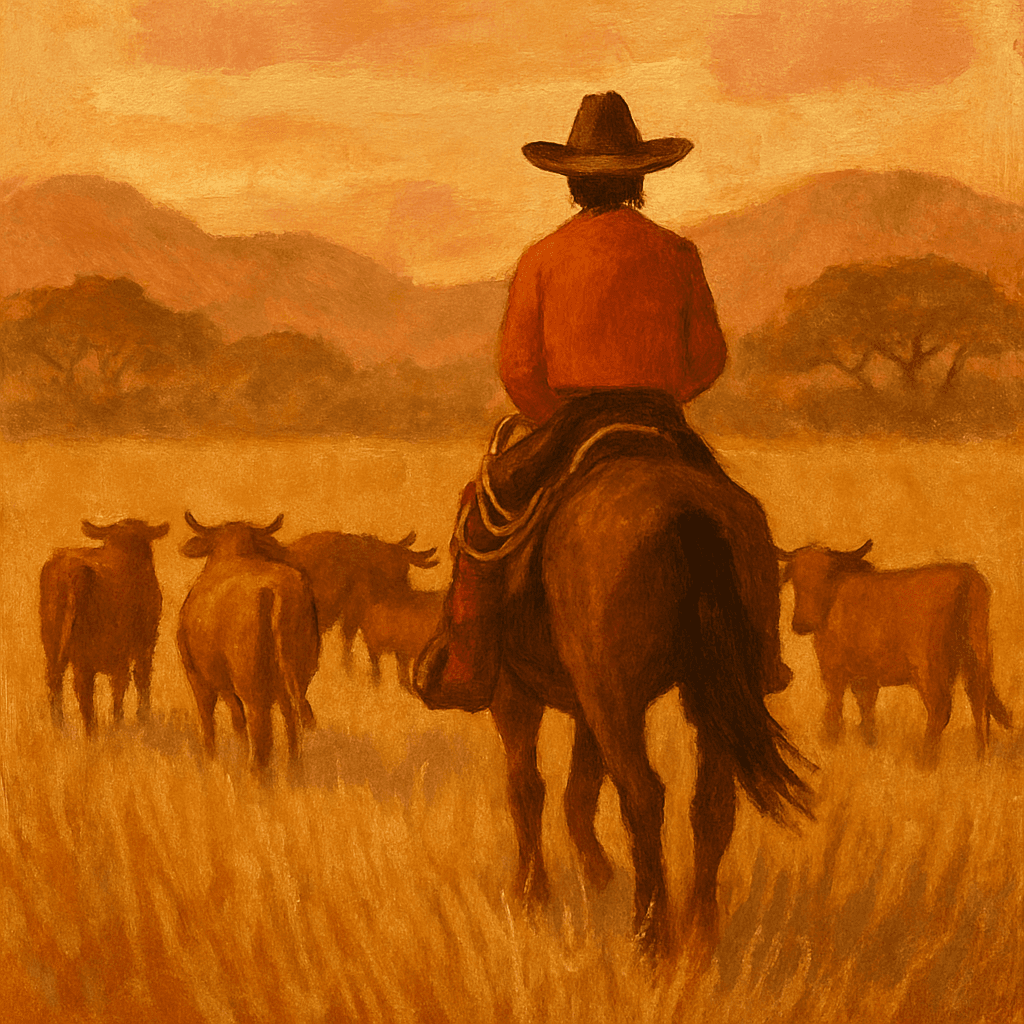
The Rider Who Is Running Out of Savanna
Esta publicación está disponible actualmente solo en inglés.
At the small-town fiestas of Guanacaste, the sabanero rides again. He comes down the main street in an embroidered shirt on a good horse, a crowd on both sides, and for the length of the tope — the ceremonial horse parade at the heart of every regional festival — he is exactly the figure Costa Rica put on its own map. It's a real tradition, not a staged one. It's also, if you watch closely, a parade of something that used to just be Tuesday.
Because the sabanero was never a costume. For a long time he was simply what Guanacaste was: cattle country, and the men who worked it on horseback. The Spanish brought cattle to the province sometime in the 16th or 17th century — the sources don't agree on the year, and neither will this essay — and over the centuries that followed, haciendas spread across the flatland between Guanacaste's two mountain ranges, breeding and driving cattle for meat, hide, and horn. The land helped: wide open grass, a long dry season that thinned the forest and kept it low, room for animals to range half-wild across enormous unfenced distances. Historians still argue over how much of that openness was already there and how much people made it — centuries of grazing and set fires kept the grass winning over the trees — but either way, by the time cattle culture took hold, Guanacaste had become the kind of country a rider could cross for a day and never reach a wall.
That's the country the sabanero was built for. He was out before the heat was — nobody works a savanna at midday, which by ten o'clock is essentially an oven with grass in it — moving cattle in the two cool hours before sunrise that no visitor ever sees. He wasn't a hired hand checking in at a farmhouse each night either. With so few workers for so much land, sabaneros often ran their stretch of savanna alone, according to the historian Soledad Hernández — a whole day's ride with no roof, no company but the cattle, a canteen gone warm by nine: tracking scattered animals, treating a wound, helping a birth, riding back only when the work was done. That freedom paid, too. By the end of the 19th century a Guanacaste hacienda hand could earn something like 0.75 to 2 colones a day — better than a coffee picker in the Central Valley, on 0.50 to 1.28. Out here labor was scarce and land was not, and the wage did the honest thing and admitted it. Weathered, self-sufficient, riding fiestas in his good shirt and cattle the rest of the year, the sabanero became something close to a regional self-portrait — the figure Guanacastecos pointed to and called us. Costa Rica made it official in 2003: Law 8394 named November 10 national Sabanero Day, honoring him, in the law's words, as a model of the Guanacastecan character.
Which is roughly when the honoring outpaced the having. The undoing had come decades earlier, and not from anything as dramatic as it deserved — it came from a road. The Inter-American Highway pushed through the province in the 1960s, and trucks did overnight what three centuries of hard country never could: they ended the cattle drive. Why walk a herd for days across open savanna when a truck moves it in hours? The haciendas that had organized the entire regional economy broke apart or became other things entirely — hotels, sugarcane, rice, the first outlines of the coastal tourism that runs Guanacaste today. Hernández describes the sabaneros of the 1970s left adrift as the old system dissolved: men with a lifetime of one hard-won skill, no more range to use it on, and no pension at the end. And yet the skill didn't vanish with the haciendas — it thinned out and held on. Out where the grassland still runs to the hills, past the resorts, you can come across a working sabanero moving real cattle in the cool before the heat, doing the thing the parade only pictures.
So here is the strange arithmetic of it. The savanna is still out there — plenty of it — and there are still working sabaneros riding real cattle across it. But the version most visitors will actually meet is the one in the parade, or the one on the wall of a resort restaurant named after him, hat and lasso reframed as decor for a lobby standing where a hacienda used to be. The all-inclusive rose on the same footprint that put the sabanero out of work, then hung his portrait by the entrance. A working life became a costume, and the costume became, for most people, the whole story — which is the one part of it he never got paid for.
Made using AI. This is a research-based post, not a first-hand account. Some particulars — the exact century cattle arrived, and how much of Guanacaste's grassland is naturally occurring versus shaped by centuries of ranching and fire — vary between sources and are noted below rather than stated as settled fact.
Sources
- Cattle introduced to Guanacaste by Spanish colonists in the 16th–17th century; haciendas established across the province in the centuries following to raise and market cattle: The sabanero's journey: from haciendas to all-inclusive resorts — Voz de Guanacaste
- The sabanero's work (herding semi-wild cattle across open savanna with minimal supervision, treating wounds, assisting births), historian Soledad Hernández on the scarcity of labor relative to land, wage comparison between Guanacaste hacienda workers (0.75–2 colones/day) and Central Valley coffee workers (0.50–1.28 colones/day) at the end of the 19th century, Law 8394 (2003) establishing November 10 as national Sabanero Day, and the decline of the role — roads and trucks ending cattle drives, haciendas converting to hotels/sugarcane/rice, sabaneros of the 1970s left without pensions: The sabanero's journey: from haciendas to all-inclusive resorts — Voz de Guanacaste
- Guanacaste's landscape shaped by mahogany logging and cattle ranching, the completion of the Inter-American Highway through the province in the 1960s and its effect on trade and isolation, the sabanero as the region's defining figure: In Costa Rica, Filibusters and Sabaneros Spice Up Guanacaste's History — The Tico Times (2022-05-29)
- On the contested origin of Guanacaste's open grassland/savanna landscape — research describing much of the area's "savanna" as anthropogenic: old, frequently-burned pasture colonized by introduced African grasses (jaragua) rather than a naturally occurring grassland, the product of four centuries of ranching, logging, and fire rather than logging alone: Área de Conservación Guanacaste — Natural World Heritage Sites
- The tope (ceremonial horse parade) and punto guanacasteco as living expressions of sabanero/cowboy culture at regional fiestas today: Guanacaste: A Wealth of Costa Rica Traditions and Culture — The Tico Times
Honesty note: the exact century cattle arrived in Guanacaste varies between sources (commonly given as 16th–17th century), so the essay does not pin it to a single date. The claim that mahogany logging and foreign timber demand "created" Guanacaste's savanna (as stated by The Tico Times) is contested by conservation-ecology sources, which describe much of the region's grassland as anthropogenic pasture — shaped by centuries of cattle ranching, burning, and the spread of introduced African grasses, on a landscape that was already forest-and-clearing rather than solid unbroken jungle — rather than simply "logged into savanna." The essay presents this as an open question, not settled fact. Some details of Soledad Hernández's account (the degree of supervision, the exact circumstances sabaneros were "left adrift" in the 1970s) come from a single interview source and are presented as her account rather than independently cross-verified record.