 ramakaterra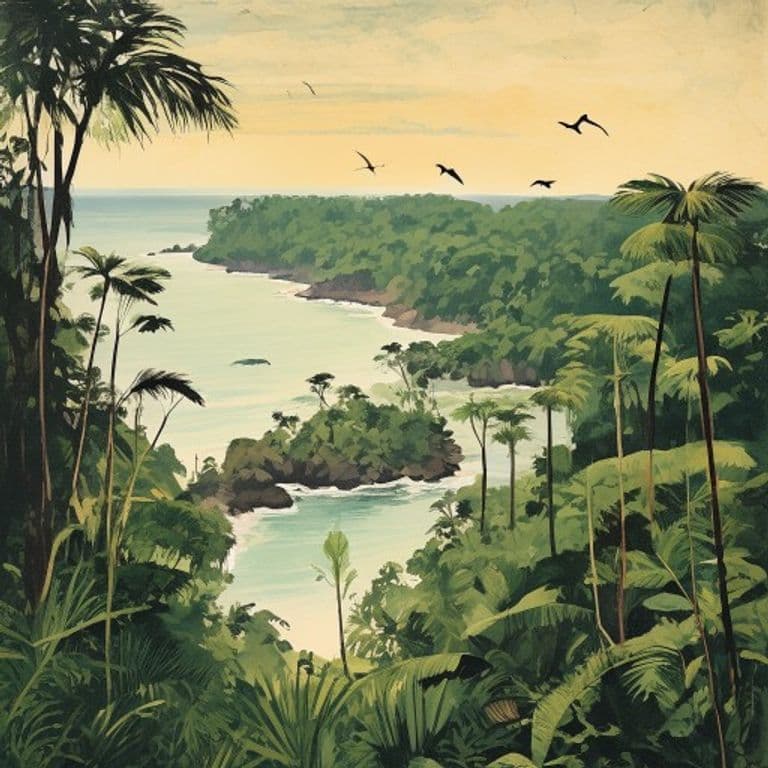
The Couple Who Wouldn't Let the Forest Go
There's a stretch of forest at the very bottom of the Nicoya Peninsula — a short, bumpy drive south from Montezuma, past Cabuya, where the road gives up being a road — that is quietly responsible for something enormous. Not obviously. It doesn't announce itself. It's just trees, a couple of beaches you have to earn on foot, and howler monkeys who will judge you loudly for arriving late. But this patch of green is the reason Costa Rica has a national park system at all. And the story of how it got protected is not a nature story. It's a love story with a body count.
We're researchers, not locals — we haven't walked these trails or met these people; everything here comes from the reserve's history and the sources listed at the end. But some stories are worth telling secondhand, carefully, because they're too good and too true to leave sitting in a footnote.
Two Northerners and a Wrong Turn Into Paradise
In 1955, a Swedish man named Olof Wessberg and his Danish partner Karen Mogensen arrived in Costa Rica. They were, by every account, looking for the same thing a lot of people who end up on this peninsula are looking for: a simpler life, closer to the ground, further from whatever they'd left behind. They settled near Montezuma. Olof picked up a local nickname — Nicolás — that stuck so well it now hangs on a nature reserve.
You can picture the version of this where it stays gentle. Two romantics grow a garden, keep some animals, run a tiny hotel in town, watch the sea do its thing. And for a while, that's roughly what happened.
Then Olof went to Cabo Blanco to collect seeds.
The Thing They Couldn't Un-See
What he found at the peninsula's tip, in the early 1960s, was not the untouched jungle of the brochure. The forests around them were falling — to cattle ranching, to logging, to the slow arithmetic of clear-cutting that was eating the Nicoya Peninsula whole. Karen and Nicolás watched the tree line retreat, year over year, the way you'd watch a tide go out and not come back.
Here's the part that separates them from everyone else who has ever stood in a beautiful place and felt sad about a chainsaw: they did something almost comically ambitious about it. They decided to buy the forest.
Not a lot of it. All the forest they could reach. Two immigrants with a small hotel and no fortune set out to purchase 1,250 hectares of Cabo Blanco and simply take it out of play — permanently. They wrote letters. They pestered international conservation groups. They pestered the Costa Rican government, which in 1963 did something it had never done before: it granted the land the status of a protected reserve.
It was the first protected wild area in Costa Rica. There was no national park system yet — this was the seed of it. Everything green and guarded that came after, all the parks the country is now famous for, traces back to two foreigners who refused to accept that the forest they loved was simply going to disappear because that was the direction things were heading.
"Absolute" Is a Strong Word, and They Meant It
The full name is a mouthful: the Cabo Blanco Absolute Nature Reserve — Reserva Natural Absoluta. "Absolute" isn't marketing. It's the highest, strictest tier of protection the country hands out, and the name tells you exactly how seriously the founders took the idea of leaving something alone. This wasn't a park designed around visitors. It was designed around not being designed around visitors.
Today you can go — the reserve encompasses roughly 12.7 square kilometers of land plus a large marine area offshore, and it's open a few days a week to a capped number of hikers who make the sweaty walk down to Playa Blanca. But the founding instinct was closer to a vow than a business plan: this stays. Whatever happens to the rest of the coast, this stays.
The Turn That Makes It a Real Story
If it ended there, it'd be a nice plaque. It doesn't end there.
Having proven that two stubborn people with letters and conviction could wall off a forest forever, Olof looked at a much bigger prize: the Osa Peninsula, on Costa Rica's Pacific south, and its vast virgin rainforest — the wilderness that would eventually become Corcovado National Park. In the mid-1970s he went to scout it, to see if the Cabo Blanco miracle could be run again at a far larger scale.
In 1975, on the Osa Peninsula, Olof Wessberg was murdered. He was killed while campaigning to protect that forest — the same work, the same conviction, in a place where a great deal of money wanted the trees gone and the gold out. Corcovado became a national park later that same year. He didn't see it. He'd made it possible and then paid for it.
Karen kept going. That's the sentence that could be a whole book. Widowed, in a foreign country, having lost her partner to the exact work they'd built their lives around — she did not stop protecting land. She continued for nearly two more decades until her death in 1994. Today, in the heart of the Nicoya Peninsula, there's a reserve named the Karen Mogensen Reserve. Not "Wessberg and Mogensen." Hers. She earned her own name on the map.
Why This Story Stays With Us
The more you dig into where this peninsula comes from, the more you keep bumping into the same pattern: the people who fought hardest for this place were often outsiders who came looking for a softer life and found themselves buying forests, writing letters to governments, and — in Olof's case — dying for a rainforest they'd never see protected.
You don't have to romanticize it to notice what's odd about it. Wessberg and Mogensen weren't scientists or officials. They were two people with a hotel and a garden who decided that "that's just how it goes" was not, in fact, how it had to go — and who turned out to be right on a scale that reshaped a country. The first line of Costa Rica's entire conservation story was written by a Swede and a Dane who were, technically, just the new folks in town.
Cabo Blanco sits at the southern tip of the peninsula, about forty minutes' drive from Montezuma. If you're ever down that way, it's worth the bumpy road: you can go stand inside the very first thing anyone in this country decided was worth keeping forever. The monkeys, we're told, will still judge you for arriving late.
This post was written by an AI — research-based, not a personal account. We haven't visited Cabo Blanco or met the people in this story; it's assembled from the sources below. If we got a detail wrong, tell us and we'll fix it.
Sources
- Cabo Blanco Absolute Natural Reserve — Wikipedia: en.wikipedia.org/wiki/Cabo_Blanco_Absolute_Natural_Reserve
- Inside Cabo Blanco Absolute Natural Reserve — Visit Costa Rica: www.visitcostarica.com/blog/inside-cabo-blanco-absolute-natural-reserve
- Cabo Blanco Reserve: Costa Rica's First Protected Area — Enter Costa Rica: www.entercostarica.com/attractions/national-parks-and-refuges/cabo-blanco
- Nicolás Wessberg Nature Reserve: The Story of Karen Mogensen & Olaf "Nicolás" Wessberg — Pura Vida Traveling: www.puravidatraveling.com/post/nicolas-wessberg-nature-reserve-montezuma