 ramakaterra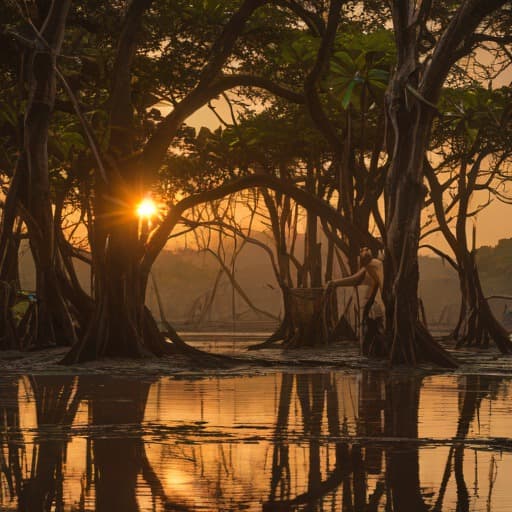
The Women Who Plant the Forest They Harvest
כתבה זו זמינה כרגע באנגלית בלבד.
Before five in the morning, in the dark, a woman wades off the shore at Chomes and into the mangrove. The tide has pulled back and left the channel floor exposed — black mud the consistency of thick batter, warm and knee-deep, that gives no resistance and no light. She reaches down along the arched roots of the red mangrove and feels, by hand, for something hard and ridged buried in it. When her fingers find one, she works it loose and drops it in the basket at her hip. Then she moves to the next root, and the next, for several hours, in mosquito country, while the sun comes up. This is a job. It sends children to school.
The thing she is feeling for is the piangua, Anadara tuberculosa, a dark, ridged clam known in English as the mangrove cockle. There is no elegant way to harvest it, because there is no other way to find it: it lives clamped around the roots, buried in the mud, invisible until a bare hand closes on it. It isn't large — a mature shell runs somewhere between 5 and 9 centimetres — and it is slow, needing about two years to reach the roughly 4.7-centimetre length at which the law allows it to be taken. That patience is the whole economy: every clam is found one at a time, on foot, at low tide, by a woman with her arm in the mud.
For generations this was a woman's trade, done informally, passed from mother to daughter. In 2017–18, in the fishing village of Chomes on the Gulf's eastern shore, fifty-three of them made it official: they organized as CoopeMoluscos Chomes, with training support from the FAO, to gather piangua and other mollusks and sell them — fresh, or turned into ceviche and empanadas — through the community and, increasingly, by phone. The return is real and modest: one member has put a typical week at roughly 40,000 to 50,000 colones, on the order of 70 to 90 US dollars. Earned directly from the mud, and by the women's own account, enough to help send their children to school.
The mud they work is one of the richest places on the planet to do it. Along roughly 112 of the Gulf of Nicoya's 150 kilometres of coastline, mangrove forest presses right up to the water — close to 20,000 hectares of it. It is a nursery in the most literal sense: shrimp, crab, and fish spend their early lives hidden in that root tangle, and its mudflats are the most important feeding ground for shorebirds in the whole country. The piangua is simply the resident that never leaves. Everything else passes through; the clam stays buried in the same square metre of mud for its whole life. So does the woman's living. If the forest goes, so does she.
Which is why the women do the thing that turns this whole story around. You would expect a harvest to strip its ground bare. They regrow theirs. In recent years CoopeMoluscos Chomes has raised an estimated 20,000 mangrove seedlings in simple nurseries, tending each for four to five weeks until true leaves appear, then transplanting them into damaged stretches of forest. They clean the sediment around the roots gently, roughly every two weeks, rather than tearing at it. And they leave the smallest clams — the ones not yet through their first reproductive cycle — in the mud to grow. The harvesters have become the mangrove's most consistent caretakers, because their income depends on the forest staying alive. In 2024 that work earned the cooperative an "Ocean for Our Planet" award from the Pierre Cardin fashion house, in the NGO category — international recognition for women who spend their mornings arm-deep in the mud.
None of this is a guaranteed truce. INCOPESCA, Costa Rica's fisheries institute, sets the legal minimum size of about 4.7 centimetres; anything smaller goes back, and harvesters need a permit. But the Gulf's own three-month closure each year — roughly May through July — targets spawning finfish like corvina, and piangua is typically exempt, managed on its own terms rather than folded into that rule. Elsewhere on the Pacific mangrove coast, studies have found piangua populations well below healthy size structure where nobody protects them; in one heavily fished stretch of Peru, the population reportedly fell more than sixfold over two decades. The women of Chomes are not treating their mud as an infinite bank. A minimum size, a permit, and a cooperative that replants what it takes is less an ironclad safeguard than a truce renewed by hand — one clam, one seedling, at a time.
There is something worth sitting with in that image: a livelihood that requires you to keep putting your bare hands into the exact ecosystem you depend on — gently enough, and often enough, that it keeps giving something back. The piangua will never be a spectacle the way a beach full of turtles is; the work is done in silence, in the dark, before anyone is awake to watch. But it is its own quiet reversal. A line of women in Chomes decided that the surest way to keep harvesting a forest is to keep it a forest worth harvesting from — and then went out before dawn, season after season, and made it true.
Made using AI. This is a research-based post, not a first-hand account.
Sources
- Piangua (Anadara tuberculosa) size structure and growth — commercial samples ranging roughly 31–92 mm, sexual maturity averaging ~48.5 mm, and regional life-history variation across the Pacific mangrove coast: Size structure, distribution, and abundance of Anadara tuberculosa in two mangrove systems from the Pacific Coast of Panama — Revista de Biología Tropical (Scielo)
- Costa Rica's legal minimum extraction size for piangua (47 mm / ~4.7 cm), the roughly 24 months needed to reach it, and the requirement to return undersized clams to the mangrove: INCOPESCA piangua management framework, referenced via INCOPESCA institutional records (AJDIP/251-2022 and AJDIP/037-2024, Golfito piangua veda orders) and associated fisheries-management documentation
- Gulf of Nicoya mangrove extent (~20,000 hectares, ~112 of 150 km of coastline), and its status as the country's most important shorebird area, with every Costa Rican shorebird species recorded there: Golfo de Nicoya — Western Hemisphere Shorebird Reserve Network (WHSRN)
- CoopeMoluscos Chomes: founding by 53 women in 2017–18 with FAO training support, harvest method and hours, ~40,000–50,000 colón weekly income, mosquito-heavy working conditions, and the mangrove's resident wildlife: The mangrove forest that feeds a Costa Rican community — El Mundo CR
- CoopeMoluscos Chomes reforestation figures (~20,000 mangrove seedlings planted over two years, 4–5 week nursery cycle, biweekly non-destructive sediment cleaning, protocol of leaving pre-reproductive clams in place), cooperative membership figures, and the 2024 Pierre Cardin "Ocean for Our Planet" award: Molusqueras de Chomes son reconocidas internacionalmente por su aporte a la reforestación de manglares — Ojo al Clima
- Gulf of Nicoya's general fishing closure (veda), roughly May 1–July 31, targeting finfish spawning (e.g. corvina) and explicitly excepting mollusk/piangua extraction with a valid INCOPESCA permit: Golfo de Nicoya entra en pausa: Inicia veda de tres meses — Infobae Costa Rica
- Piangua population decline in Peru's Tumbes region (reported more than sixfold reduction 1988–2008 in unprotected areas) as a regional overexploitation reference point: mtDNA phylogeography and demography study of Anadara tuberculosa across the East Pacific, PMC6476791 — NCBI
Honesty note: sources disagree on the exact membership of the Chomes cooperative at different points — some put it at "53 women," others at "52 affiliates, 47 of them women" — so this piece uses the harvester-founding figure (53 women, 2017–18) rather than picking one current membership count as settled. The 47 mm minimum legal size and roughly 24-month growth period are consistently reported in Costa Rican fisheries-management sources, but this piece did not access INCOPESCA's primary regulatory PDF directly (it returned a server error on fetch) — the figures are corroborated across secondary summaries of that same regulatory framework, not confirmed against the raw text. Importantly, the Gulf of Nicoya's well-documented three-month closure is a finfish veda that explicitly exempts piangua and other mollusks with a permit — it is not, itself, a piangua-specific closed season. Piangua-specific harvesting bans have been formally decreed elsewhere on Costa Rica's Pacific coast (notably in Golfito's mangroves), and this piece does not claim the Gulf of Nicoya has had an equivalent piangua-only veda; the clam there is instead managed through the minimum-size rule, permitting, and the harvesters' own protocols. The sharp population-decline figure cited (more than sixfold) is specific to Peru's Tumbes region, not the Gulf of Nicoya, and is included only as a regional cautionary data point, not a claim about local stock health, which this piece did not find hard population data on either way.