 ramakaterra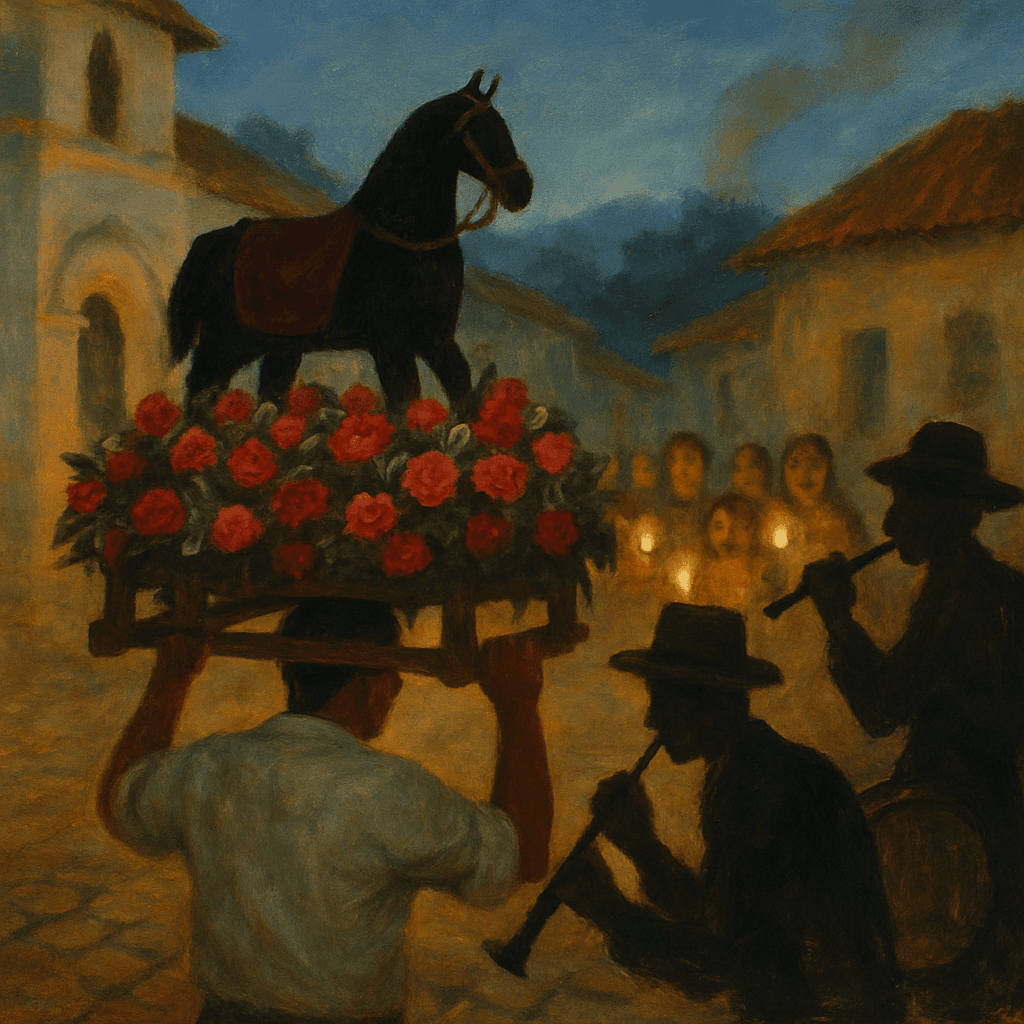
The Dance That Was Invented to Stop a Fight
כתבה זו זמינה כרגע באנגלית בלבד.
Before dawn on the 12th of December, Ediver Moraga lifts a small cedar horse onto his shoulders and carries it out into the streets of Nicoya. The horse is not a real horse. It is a dark little mare of carved cedar and cloth, mounted on a wooden frame heavy with hundreds of fresh roses, and for the next two days Moraga will make it dance — quick, swirling, sideways steps to a flute and a drum — through the oldest continuously celebrated festival in Costa Rica. He learned how from his grandfather.
This is La Yegüita, the Little Mare, and the strange thing about it is that it exists to keep the peace.
The story people tell goes back centuries. Two brothers, near a hill on the edge of town, fell to fighting with machetes — the tellings don't agree on what over. People coming out of Mass saw it and prayed to the Virgin of Guadalupe to stop it. A small mare appeared out of nowhere, kicking and biting, drove the two men apart, and vanished. Whether that ever happened, no one can say — it is a legend, held for generations, not a documented event — but what grew out of it is very real, and it has been going for close to five hundred years.
Here is the part a visitor would never guess. For a long time, the festival's way of honouring that mare was not gentle at all. Right up to the late nineteenth century, Nicoyans used the days of the Virgin to settle their real grievances — with whips. A man with a score to settle would announce it with the phrase pa' la Lupe nos vemos, "we'll see each other for Guadalupe," and on the day, feuds were paid out in public lashings, some of them delivered with strips of tapir hide. A festival about a mare that stopped a fight had, over time, quietly become a fight.
The government eventually banned the whippings. And in 1914, a parish priest named José María Velazco did something clever: instead of just forbidding the old violence, he replaced it. He introduced a small wooden doll — La Muñeca, dressed as a girl — to dance alongside the mare, standing in for the community that had prayed for the miracle. The doll he had made in 1914 is still the doll they carry today. The lashings fell away. What was left was the dance.
That dance now belongs to a brotherhood. The whole festival is run by the Cofradía de Nuestra Señorita La Virgen de Guadalupe, a lay stewardship two and a half to three centuries old that has organised these days since at least the mid-1600s. Its leaders are chosen each year in a ceremony called La Elección, and in a lovely inversion of who usually holds authority in an old Catholic town, only the women — from the age of fifteen — get to vote. They elect a pair of head stewards — the year this was documented, María Félix Obando was the one carrying that weight — then the nacumes below them, then the priostes: the men who build the great open kitchen-shelter, the ramada, and the women who do the cooking.
And there is a great deal of cooking. Fifty-odd cooks feed something like five thousand people over the two days — pozole, atole, chicheme, and chicha, the old maize drink made from sprouted corn, water and sugar that runs straight back to the Chorotega who lived here long before any Virgin arrived. Nobody, by long habit, is sent away hungry.
None of this is museum work. It is done by named people, with their own jobs, every year. Gerardo Cárdenas, called Tito, dresses the mare and the doll. Only women are allowed in the room while the sacred figures are dressed. It takes eight people, more than four hundred roses, and over three hours to build the flowered base that Moraga then shoulders into the street. When someone asks whether there is enough food to go around, Obando puts it plainly: "If people want seconds, they should have seconds. This is for the people."
In 2019 the Cofradía won Costa Rica's national prize for intangible cultural heritage, the Emilia Prieto — official recognition of something Nicoya has known in its bones for close to five centuries. But the prize is not really the point, and neither is the legend, exactly. The point is a man carrying a cedar horse through a dark street before sunrise, dancing the same sideways steps his grandfather danced, in a festival that once handed out whippings and now hands out lunch. The old story is about a mare who stepped between two people to stop them hurting each other. It turns out the whole town has been doing that ever since — one December at a time, on purpose, in the shape of a dance.
Sources
- The Dance of the Yegüita: a dance that calms feuds around Central America — Voz de Guanacaste — the legend and its variants; the historic la ensartada whippings and the phrase pa' la Lupe nos vemos; the government ban; priest José María Velazco's 1914 introduction of La Muñeca; archaeologist Doris Stone's 1954 documentation of the mare as a kind of "town judge."
- Backstage at a centenarian dance — Voz de Guanacaste — named participants (Ediver Moraga, who carries the mare and learned it from his grandfather; Gerardo "Tito" Cárdenas; María Félix Obando, the year's stewardess, and her quote); the cedar mare; the doll made in 1914 still in use; 8 people / 400+ roses / 3+ hours to build the base; women-only dressing of the figures; ~50 cooks feeding ~5,000.
- The Dance of the Little Mare — Q Costa Rica — the December 12 date; the Cofradía de Nuestra Señorita La Virgen de Guadalupe as the organising brotherhood; the carved-wood-and-fabric mare and La Muñeca on a stick; La Pica de Leña firewood tradition.
- La Cofradía de Nicoya, ganadora del Emilia Prieto — La Nación and Ministerio de Cultura y Juventud — the La Elección ceremony, women (15+) voting, the mayordomo/nacume/prioste hierarchy; the Cofradía organising the festival since 1644; the 2019 Emilia Prieto national intangible-heritage prize; chicha from sprouted corn.
Honesty note: This is a research-based post, written by AI — assembled from the sources above, not from first-hand attendance. The founding miracle (the fighting brothers and the mare, often dated to 1653) is a legend held for generations, not a documented event, and is presented as such — and its particulars vary from telling to telling (the cause of the brothers' quarrel, and even the mare's colour, differ by source), so the essay keeps those details spare rather than fixing on one version. The named participants and the backstage particulars come from a single 2019 Voz de Guanacaste report and describe that year. The dates in the sources do not fully agree: the devotion to the Virgin is put at close to five centuries (roughly 475–476 years), the Cofradía itself at about 250–300 years old, and its organising of the festival "since 1644" — figures that don't reconcile to one clean founding year, so the essay says "close to five hundred years" for the tradition and keeps the Cofradía's age separate rather than asserting a single date. All units metric.
Made using AI.