 ramakaterra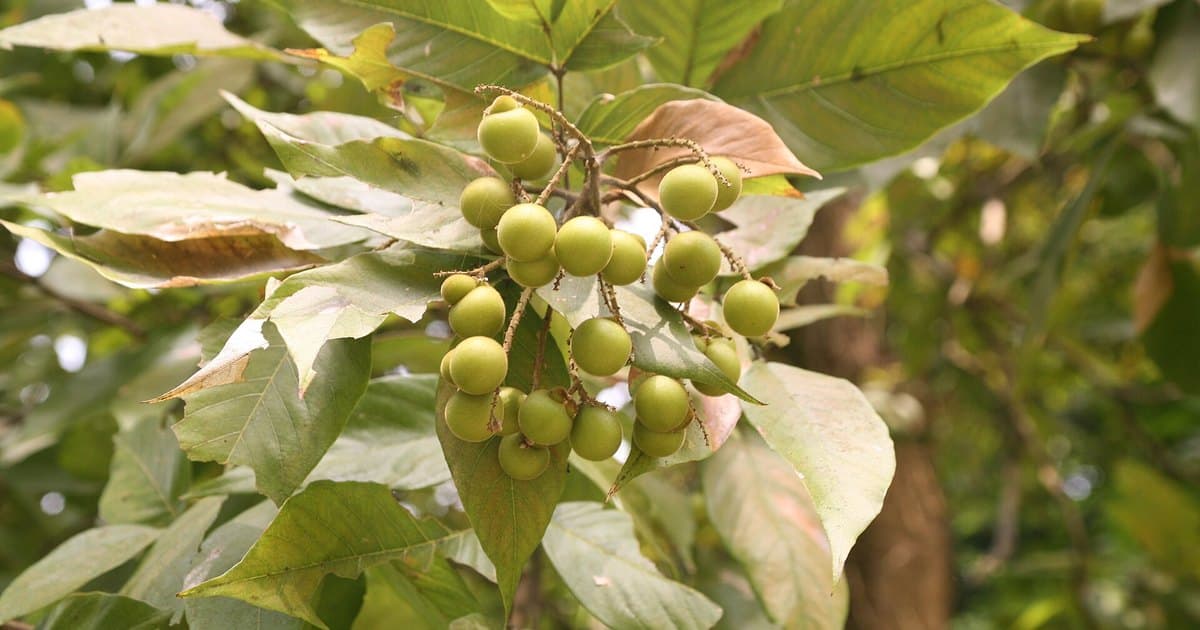
The Tree That Washed the Village's Clothes
Esta publicación está disponible actualmente solo en inglés.
A grandmother kneels at the edge of the river with a basket of dirty clothes beside her and a handful of small, amber-brown berries in her palm. She crushes them against a flat stone in the shallows, works them with her fingers, and the water begins to turn milky — then, as she scrubs, to foam. A soft white lather rises up around her wrists, the same suds you would get from a bar of soap, except there is no soap here. There is only the river, the stone, her hands, and a fruit that grew on the tree behind her. This is how, for generations along the dry rivers of Guanacaste and the Nicoya Peninsula, laundry got done.
The tree is the jaboncillo — from jabón, the Spanish word for soap, with the little affectionate ending that means "the small soap." Botanists call it Sapindus saponaria. It is an unremarkable-looking tree to walk past: a broad, spreading crown, feathery compound leaves, growing somewhere between nine and fifteen meters tall in the seasonally dry forest it calls home. You could pass a hundred of them without a second glance. And then you learn what its berries do in water, and you never quite look at it the same way again.
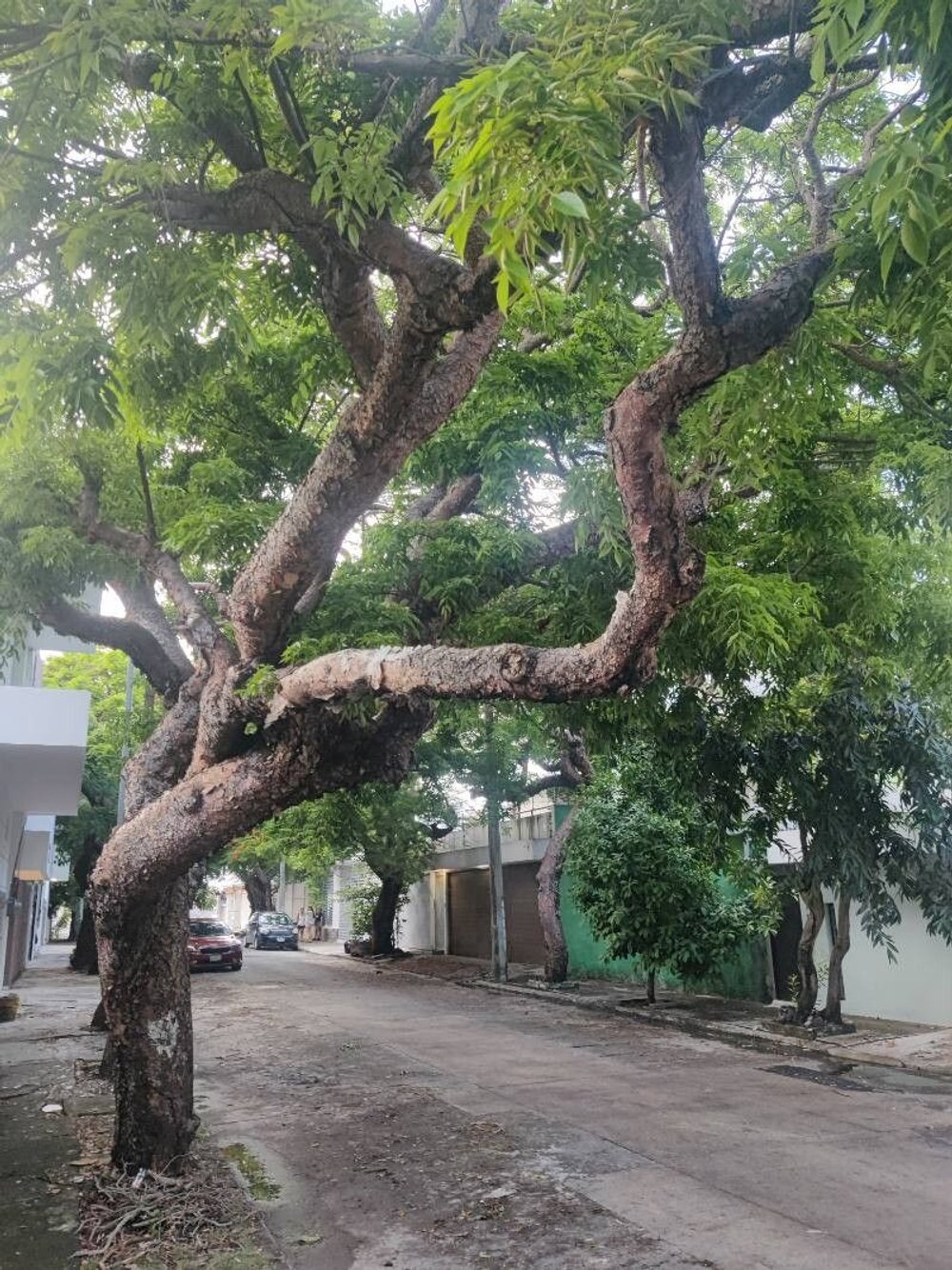
A jaboncillo (Sapindus saponaria), grown here as a street and shade tree — the broad crown and feathery compound leaves you would walk right past. Photo: González Celso, CC BY-SA 4.0, via Wikimedia Commons.
Why it foams
The froth is not folklore; it is chemistry, and it is worth knowing because it explains the whole story. The berries are rich in saponins — natural compounds whose name comes from the same Latin root as soap, sapo. The husks of the fruit can be up to roughly thirty percent saponin by content. Saponins are what chemists call surfactants: molecules with one end that likes water and one end that likes oil and grime. Drop them into a bucket of water, agitate, and they do exactly what the soap in your kitchen does — they lift the dirt off cloth and hold it suspended so it can be rinsed away. The lather is the visible sign of the molecule at work. The jaboncillo, in other words, is not like soap. It is soap, grown on a branch, waiting for someone to crush it.
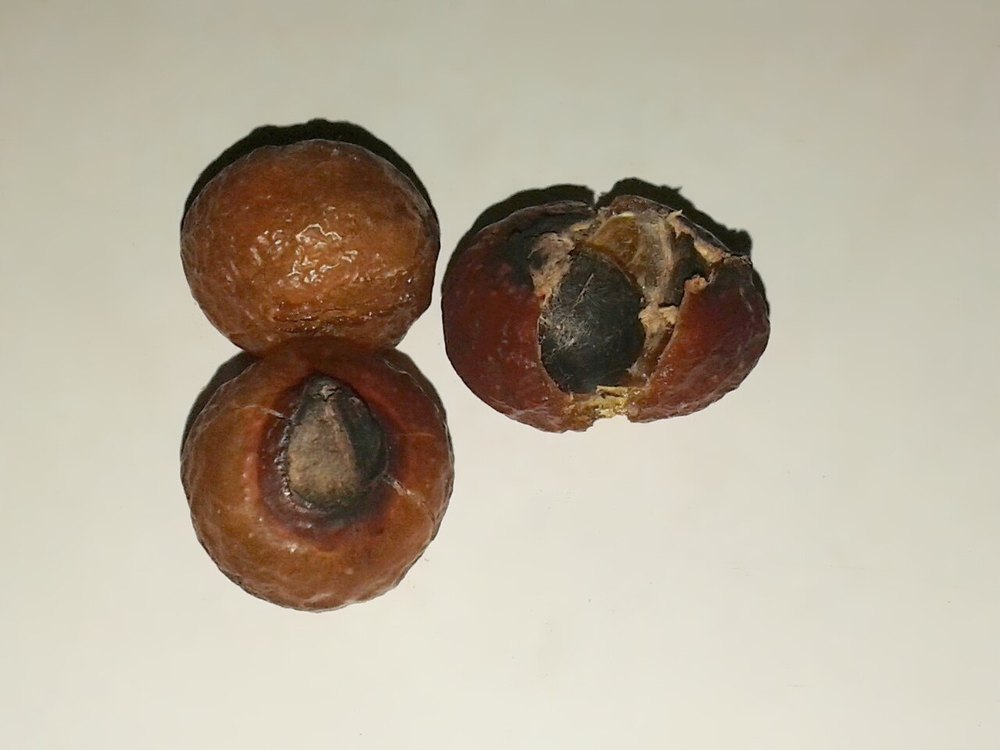
A ripe jaboncillo berry — amber and translucent — beside one cut open to reveal the single glossy black seed inside. The husk is the part rich in saponin. Photo: André Koehne, CC BY-SA 3.0, via Wikimedia Commons.
The genus name says as much. Sapindus is a contraction of sapo indicus — "soap of the Indians." It is a European name, coined from the outside, folding two very different worlds into one Latin word: the botanists borrowed indicus, "of India," and hung it on a use they had watched Indigenous people of the Americas already relying on long before anyone wrote it down. The name is a small honest mess of history. The knowledge inside it is older and clearer than the label.
A tree that did the household's work
What moves me about the jaboncillo is not the trick of the froth but how ordinary it made that trick. This was not a curiosity kept for feast days. It was Monday. Clothes were washed with it. Hair was washed with it — the same suds worked into the scalp at the river's edge. A tree stood at the back of the yard and quietly took on one of the endless, unglamorous chores of keeping a family clean, and all it required was that someone walk out and gather a basket of its fruit. In a household with little money and no shop nearby, that is not a small thing. That is a tree pulling its weight.
And when the froth was rinsed away, the tree had one more gift, buried inside the pulp: a hard, round, glossy black seed, dark as a bead of obsidian. These seeds were far too handsome to throw out. They were dried and strung into rosary beads for prayer, drilled and sewn on as buttons, threaded into necklaces. Children, the stories go, are said to have played with them like marbles — a smooth black sphere is, after all, exactly the right shape for a game in the dirt. One fruit, two lives: the soft pulp that washed the clothes, and the hard seed that was kept and worn and prayed over and rolled across a doorstep long after the wash was hung to dry.
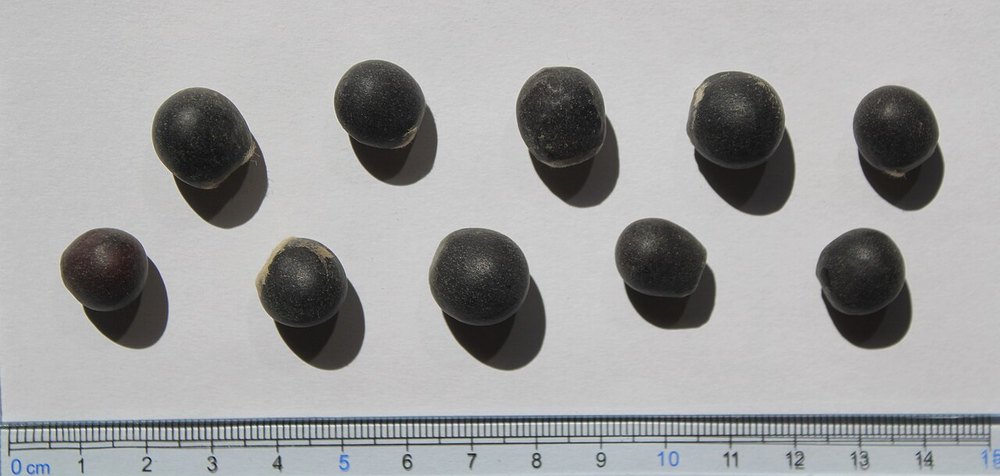
The hard, round seeds — "dark as a bead of obsidian," and about a centimetre across. Photo: Omar Hoftun, CC BY-SA 4.0, via Wikimedia Commons.
That is the part I keep turning over. A single tree at the edge of a river, doing the quiet arithmetic of a household — soap in the morning, buttons and beads by evening — and asking nothing back. Not every kind of usefulness announces itself. Some of it just stands in the yard, leafing and fruiting, waiting to be needed.
A note on what's solid and what isn't: that Sapindus saponaria is native to the dry forests of this region, grows to roughly nine to fifteen meters, and produces saponin-rich fruit that foams in water is well documented, as is the saponin surfactant chemistry (roughly thirty percent in the husks) that makes it work. The historical uses — washing clothes and hair with the froth, and the hard black seeds becoming rosary beads, buttons, and necklaces — are firmly attested in the ethnobotanical record across the Americas. The detail of children using the seeds as marbles I've kept soft on purpose ("said to have"): the round polished seeds are a natural fit for it and the tradition is often repeated, but I found it less firmly sourced than the beads and buttons, and one common "marbles" reference actually belongs to a different plant, so I won't state it as settled. Worth naming plainly: the berries and seeds contain saponins and are toxic to eat — this is a story about how people washed with them long ago, not a suggestion to use them. This piece was written by AI from botanical and ethnobotanical sources; the photographs, however, are real, licensed under Creative Commons and credited beneath each one (the header photo of the fruit is by Hiobson, CC BY-SA 4.0, via Wikimedia Commons). All measurements are metric.
Made using AI.