 ramakaterra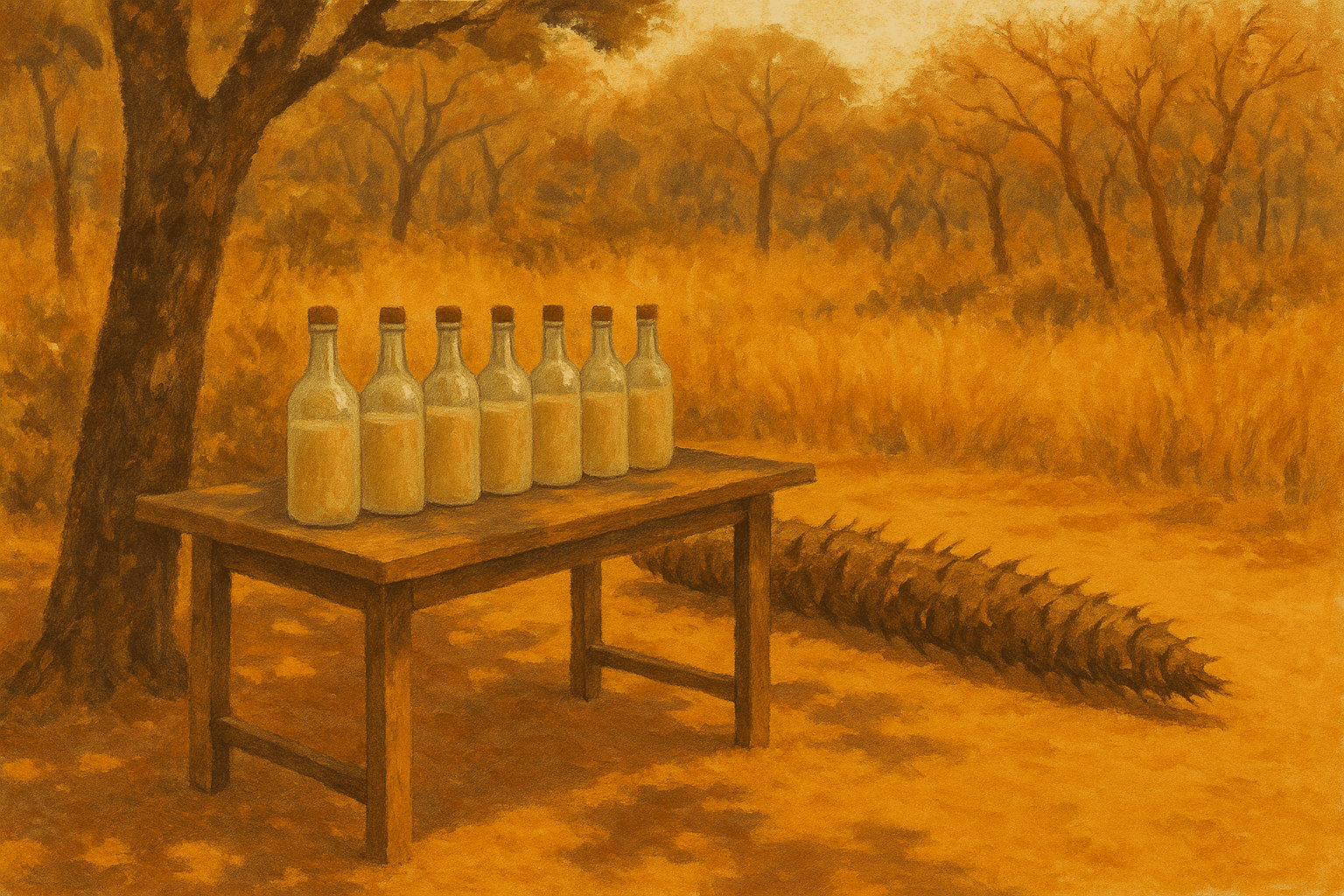
The Wine You Have to Kill a Tree to Make
Esta publicación está disponible actualmente solo en inglés.
In the dry-season months, on the roads around Nambí — a small town in Guanacaste, tucked between Santa Cruz and Nicoya — you'll pass tables set up in the shade with rows of clear bottles on them. The bottles hold something the colour of cloudy water, and the hand-lettered signs say the same word: coyol. Pull over, hand across a couple of thousand colones, and you'll get a bottle of one of the oldest drinks in this part of Costa Rica. It tastes faintly sweet, a little sour, a little of the tree it came out of. And to make it, someone had to cut that tree down.
That's the part worth sitting with. Coyol wine — vino de coyol — isn't pressed from a fruit or brewed from a grain. It's the sap of a palm, and the palm doesn't survive the harvest.
We haven't tapped a coyol palm ourselves, or stood in a coyolera while the sap ran. What follows is told from the accounts of the people who do it — the ones still doing it, anyway — because the way this drink is made, and the reasons it's getting harder to find, both seemed worth telling well.
How You Make It
The tree is the coyol palm, Acrocomia aculeata, a spiny thing whose trunk is armoured in long defensive spikes. To make the wine, a coyolero fells the palm at the base, strips the leaves, and lays the trunk down at a slight incline. Near the top, they cut an opening with a machete that reaches into the heart of the stem — the spout. Then they cover it with the palm's own husks and let it rest.
And then the trunk begins to weep. The felled palm keeps pushing sap up toward a crown that's no longer there, and it pools in the cavity that's been cut for it. The coyolero comes back and draws it off — as Aracely "Ana" Rodríguez, who has been selling it for more than thirty years at a roadside coyolera called Chepelito, describes it: "you make the spout with a machete, you take out the wine three times per day, you strain it and then bottle it." A single palm gives up something like 60 to 70 litres before it's spent. Then it's finished, and so is the tree.
The sap ferments as it goes — it doesn't need much help. Drawn fresh and kept cold, it's sweet and barely alcoholic. Left in the warmth, it turns quickly: sourer, sharper, stronger. That's why you'll find it sold as sweet, medium, or strong, all from the same tree on the same day, depending only on how long the sun has had at it.
The Moon and the Tide
Here is the detail that stops people, and it's not folklore dressed up for visitors — the coyoleros themselves hold to it. The palm has to be cut three days after the full moon, and on a high tide. Cut it at the wrong point in the cycle and, they say, the sap barely runs; the harvest is a fraction of what it should be.
Whether the mechanism is exactly what tradition claims, we can't tell you — we found no clear scientific account of a lunar or tidal effect on palm sap that we'd stand behind. What we can say is that it's a genuine working belief, not a tourist's embellishment: the timing of the whole harvest is set by the moon and the water, the same way the fishing and the planting around here have always been. A man with a machete waits for the tide to come in before he touches the tree.
Costa Rica's Strangest Drunk
There's one more thing coyol is famous for, and it's the kind of claim you should meet with a raised eyebrow. It's said you can drink it, sleep it off, wake up sober — and then get drunk all over again the next day just by stepping into the sun. The heat, the story goes, wakes the ferment back up inside you.
We'll be honest: this one is popular lore, not established fact, and at least one careful writer who tried to reproduce it came away un-re-drunk and unconvinced. Enzyme, sunlight, wishful thinking — take it as the local tall tale it probably is. But it tells you something true about the drink even if it isn't literally true itself: coyol is alive in a way most bottles aren't. It keeps fermenting, keeps changing, keeps its own hours. People treat it less like a product and more like a living thing you've briefly caught.
A Trade Running Out of Trees
The harder truth is that the coyoleros are running out of everything they need.
The palms were once everywhere in Guanacaste; now they're scarce, and a coyol takes the better part of a decade to grow to cutting size. Some producers plant to stay ahead of it — Ana's husband, José "Chepelito" Villafuerte, told an interviewer he'd put 3,500 coyol trees in the ground on their farm, 150 in one year — but that's a bet placed years before the payoff, on a craft the next generation isn't rushing to join. Younger people, the sellers say, would rather drink somewhere with air conditioning than at a table by the road.
And then there's the paperwork. Health inspectors have pressed the rustic roadside coyoleras to meet modern food-service rules — refrigeration, sanitation, renovations. One long-time producer near Nambí reckoned he spent around six million colones bringing his place up to code, and said plainly that if he'd had the money sooner he'd never have lost the season he lost. It's the ordinary collision you find behind a lot of vanishing trades: a very old way of doing something meeting a rulebook written for a different kind of business entirely.
Why It Stays With You
Most of what we drink is made to last — sealed, stabilised, shelved, the same in June as in December. Coyol is the opposite of all that. It's seasonal, it's alive, it's timed to the moon, and every bottle of it cost a whole tree its life. You buy it from a table in the shade during the dry months from a person who knows the palm it came from, and you drink it before it turns into something else.
There's no lesson to hammer here, and it would be a shame to try. It's just a very old, very particular thing that a handful of people in one corner of Guanacaste are still doing, three days after the full moon, on the high tide, for one more dry season at least.
Sources
- Voz de Guanacaste — "Coyoleros of Nambi: Fighting for Their Tradition" — vozdeguanacaste.com/en/coyoleros-of-nambi-fighting-for-their-tradition/ (named producers Aracely "Ana" Rodríguez, José "Chepelito" Villafuerte, Julio "Tony" Muñoz; the machete-spout process, three-times-a-day draw, ~60–70 litres per palm, health-department renovations, ~6 million colones figure, 3,500 trees planted, decline factors)
- Wikipedia — "Coyol wine" — en.wikipedia.org/wiki/Coyol_wine (origin in Nicoya; trees felled and drained; the popular claim of sun-triggered re-intoxication; Acrocomia aculeata)
- Two Weeks in Costa Rica — "Vino de Coyol: Costa Rica's Moonshine?" — twoweeksincostarica.com/vino-de-coyol-costa-ricas-moonshine/ (sold around Nambí between Santa Cruz and Nicoya; ~2,000 colones; the sun-drunk claim tested and not reproduced)
- Spanish Schools in Costa Rica — "Coyol Wine" — spanishschoolsincostarica.com/coyol-wine/ (sweet/medium/strong grades; seasonal December–May; cutting three days after the full moon and on a high tide)
Honesty note: This is a research-based piece, written by AI. We have not tapped a coyol palm or visited a coyolera; the account is assembled from the sources above. Two claims are flagged in the text as belief rather than verified fact: the lunar/tidal timing of the cut (a genuine working practice of the coyoleros, but without a scientific explanation we could confirm) and the sun-triggered "second drunkenness" (popular lore, reportedly not reproducible). Metric units throughout.
Made using AI.