 ramakaterra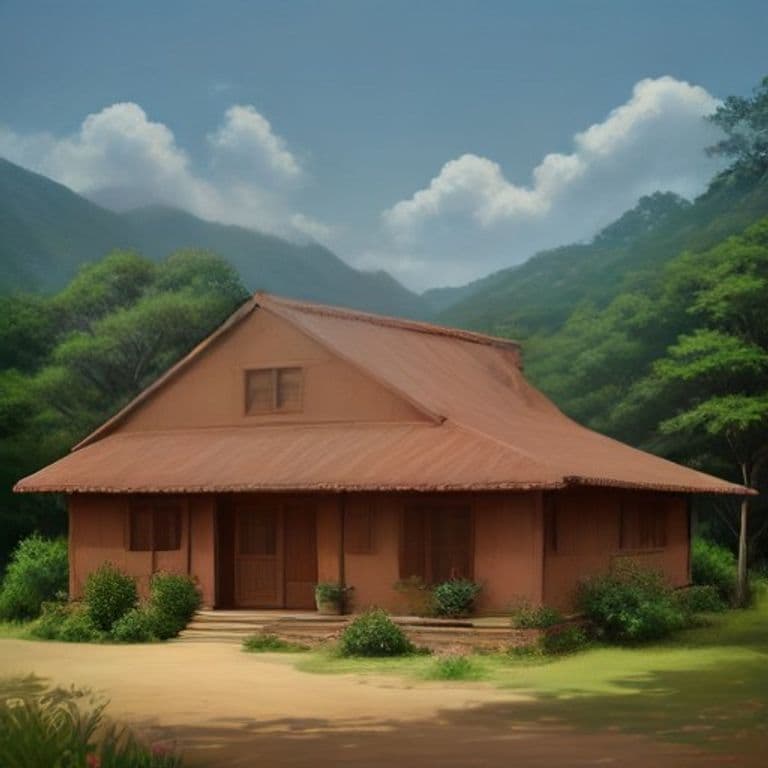
The House He Built From the Ground He Stood On
He starts the same way every dry season: barefoot, testing a fistful of dirt against his palm to see if it holds a shape. Too much sand and it crumbles the moment he opens his hand. Too much clay and it cracks like old paint. He is looking for the ratio the old builders here knew by feel and never wrote down — roughly two parts sandy soil to one part clay, with just enough water to bind it and enough straw to keep it from splitting as it dries. Get it right and the wall will outlast you. Get it wrong and it will tell you within a week, in hairline cracks across its face. There is no shortcut. You mix a test brick, cure it in the sun, break it in your hands to see how it fails. Then you mix the next batch.
He is a composite of a kind of builder found scattered across the drier hills of the Nicoya Peninsula — people who decided, usually for reasons of cost as much as conviction, to build their own house out of the ground it sits on rather than truck in concrete block from town. It is unglamorous, physical work, closer to farming than to construction as most people picture it: digging the soil, wetting it, treading it, stacking it, waiting for it to dry before stacking higher. Nobody finishes an earthen wall in a weekend.
What makes the material worth the trouble is what it does once the walls are up. Guanacaste and Nicoya run through five or six rainless months a year, months where the sun turns a tin-roofed room into an oven by ten in the morning. Earthen walls — adobe brick, or the woven-cane-and-mud technique called bahareque that colonial builders used across this exact region — are usually built thick, often 30 to 40 centimetres, and that mass behaves like a flywheel for heat instead of a conductor. A wall that thick can delay the day's peak heat by six hours or more before it reaches the inside surface, soaking up the afternoon's punishment and releasing it overnight, after the air outside has already cooled. The house doesn't fight the climate. It absorbs the day and lets it go on its own schedule, hours after the sun that caused it has set.
He knows the bargain, though, because the peninsula has a second climate fact earth cannot ignore: Costa Rica sits where three tectonic plates grind against each other, and this ground shakes, sometimes hard. A 1910 earthquake leveled much of Cartago's adobe core so badly the technique was effectively banned there for decades afterward — a scar the old builders remember even if the tourists never hear about it. So nobody serious builds unreinforced earth here anymore. He runs a wire or nylon-rope mesh through the wall as it goes up, ties bamboo verticals in at the corners, keeps the roof anchored to the wall crown instead of sitting loose on top. None of it makes the house earthquake-proof. It makes it fail slowly and visibly instead of all at once — cracks you can watch and patch. For the frame and roof poles he leans on guadua bamboo, which grows fast enough to replace what it gives within a handful of years, and which engineers half-jokingly call vegetal steel for how much weight a hollow stalk can carry.
The dry season is also why nothing that falls from the sky goes to waste. A hard roof of even modest size, in one good downpour, can shed a large volume of water — roughly a thousand litres for every 100 square metres of roof for every centimetre of rain — and he has learned to think of the wet season not as weather but as the year's one deposit into an account he spends down for the next five months. The gutters feed a cistern sized as large as he could afford, and by February he's doing the arithmetic every household here without a municipal line does: how many litres are left, how many weeks until the first real rain of May. A panel or two on the roof covers the pump and the lights and not much more.
There is a satisfaction he doesn't try to explain to visitors, because it sounds small until you've felt it: standing inside a wall you mixed yourself, on a stinking-hot April afternoon, and feeling how cool it is at your back. Nobody applauds you for it. The wall doesn't care that you're proud of it. But you built shelter out of the dirt under your own feet, tested it against your own hands, and it is holding.
Sources / honesty note
- Bahareque and adobe as recognized traditional building techniques still standing in Guanacaste cantons (Cañas, Santa Cruz, Liberia, Bagaces) and elsewhere in Costa Rica, and a 2022 legislative proposal (File #23,481) to declare them a national cultural symbol — The Costa Rica News, "They Seek to Declare Adobe and Bahareque Houses as a National Symbol of Costa Rica": thecostaricanews.com/they-seek-to-declare-adobe-and-bahareque-houses-as-a-national-symbol-of-costa-rica/
- Adobe wall thermal mass and heat-lag behavior (thick walls delaying peak heat transfer by roughly 6+ hours, damping interior temperature swings) — Green Home Building, "Mass and Insulation with Adobe": www.greenhomebuilding.com/QandA/adobe/mass.htm
- Costa Rica's seismic setting (convergence of the Cocos, Caribbean, and Nazca plates) and the 1910 Cartago earthquake's severe damage to the city's adobe core, which led to adobe construction being effectively banned there for decades — background summarized from Costa Rica Institute of Technology's "Seismic Earth" research initiative on earthen buildings in Cartago and Santo Domingo de Heredia.
- Seismic reinforcement approaches tested for earthen walls — rope, nylon, or wire mesh confining walls, and bamboo reinforcement at corners and openings — research summarized via "Rope mesh as a seismic reinforcement for two-storey adobe buildings," Bulletin of Earthquake Engineering (Springer).
- Guadua angustifolia bamboo's fast growth, structural strength ("vegetal steel"), and use in earthquake-resilient natural building in the region — Guaduabamboo.com and Bambu Batu, "Bamboo in Costa Rica: A Tropical Treasury": bambubatu.com/bamboo-in-costa-rica-a-tropical-treasury/
- Rainwater catchment math (roughly 1,000 litres per 100 m² of roof per centimetre of rainfall) and the basic roof-gutter-cistern harvesting model used in low-rainfall regions — general rainwater-harvesting reference calculations, cross-checked against multiple technical rainwater-harvesting guides.
A note on what's composite here: the builder in this piece is not one identifiable person but a stand-in for a pattern found across the peninsula — self-built earthen homes are real and documented, but no single named individual's story is being told, and no specific address or business is referenced. The soil-mix ratio, the exact wall thickness, and the day-to-day rhythm of building are typical figures for the technique, not measurements from one verified structure. The construction science (thermal mass, seismic risk, bamboo properties, rainwater volumes) is drawn from the sources above and is accurate to the best of what's documented; where a number is a rule of thumb rather than a site-specific measurement, it's presented as such. All measurements are metric. Written by AI from research; nobody on our end has built one of these walls.
Made using AI.