 ramakaterra
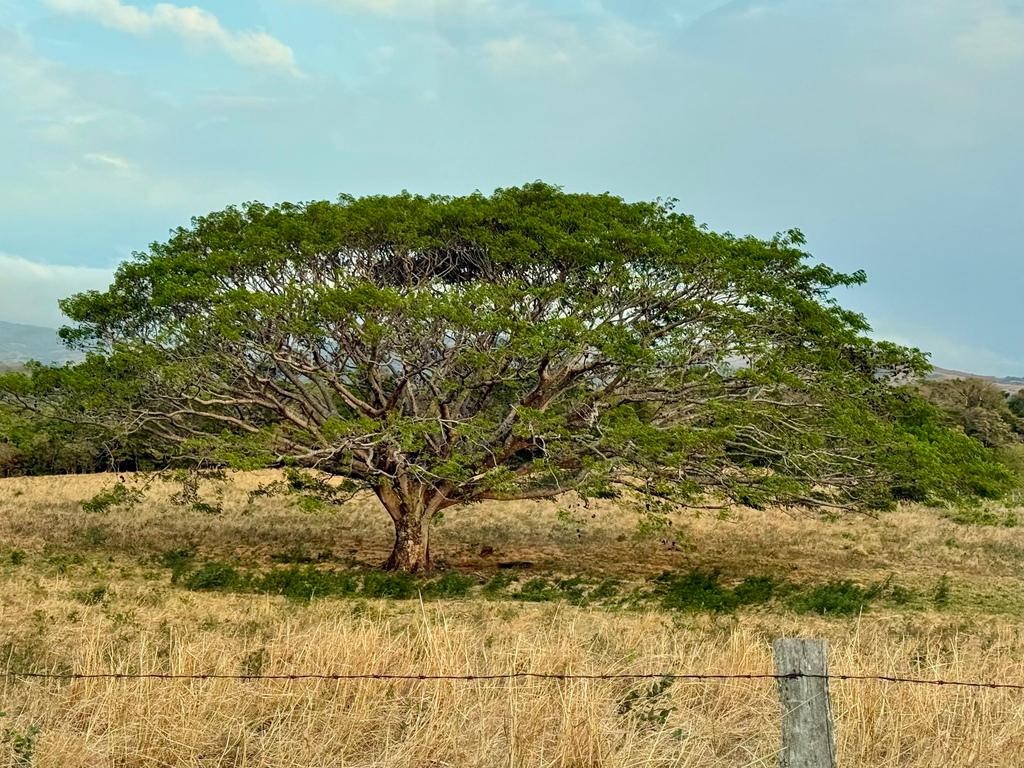
The Trees That Feed the Ground They Stand On
A particular branch of the legume family hosts colonies of bacteria — commonly genera like Bradyrhizobium and Rhizobium — in nodules on its roots. Those bacteria do something almost nothing else alive can: pull nitrogen straight out of the air and convert it into a form plants can use, the one nutrient that limits growth more than almost any other. The tree feeds itself first, then leaks the surplus to everything nearby — through fallen leaves, pruned branches, and roots that die and rot in place.
Not every legume does this, though. Nodulation is common in the mimosoid and faboid groups but largely absent from the caesalpinioids, so every species below was checked at the genus level, not assumed from the family tree. What follows is a catalog of 15 nitrogen-fixing trees that show up across this part of Costa Rica — in living fences, coffee farms, pasture, and the scrappy new growth on an old clearing.
Madero negro
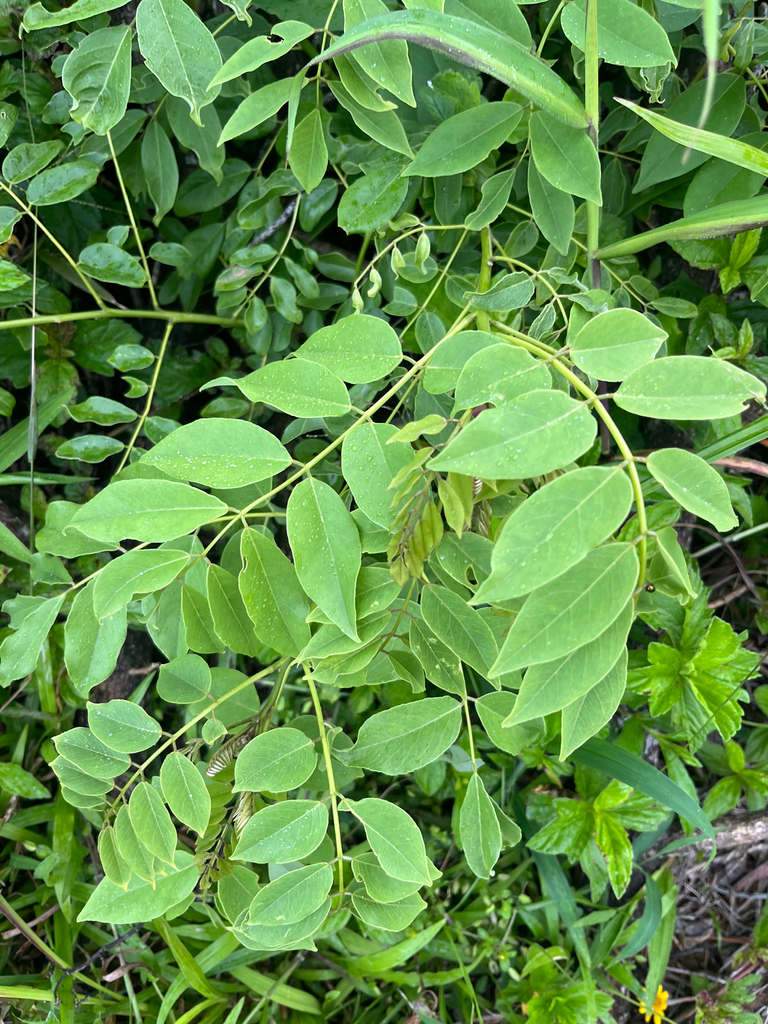
Scientific name: Gliricidia sepium
Status: native
Height: 10–12 m (up to 15 m in some stands)
Canopy width: ~5–7.5 m (variable — often kept smaller as a pruned living fence)
Leaves: drought-deciduous in the dry season; can flush evergreen and flower sporadically where rain falls year-round
Special features: Known as "quick stick" for a reason — a cut branch jammed straight into the ground roots and leafs out on its own, which is a large part of why it may be the most-planted living-fence tree in the tropics. Farmers prune it hard each year, and the cuttings fall as mulch exactly where the soil needs them.
Leucaena
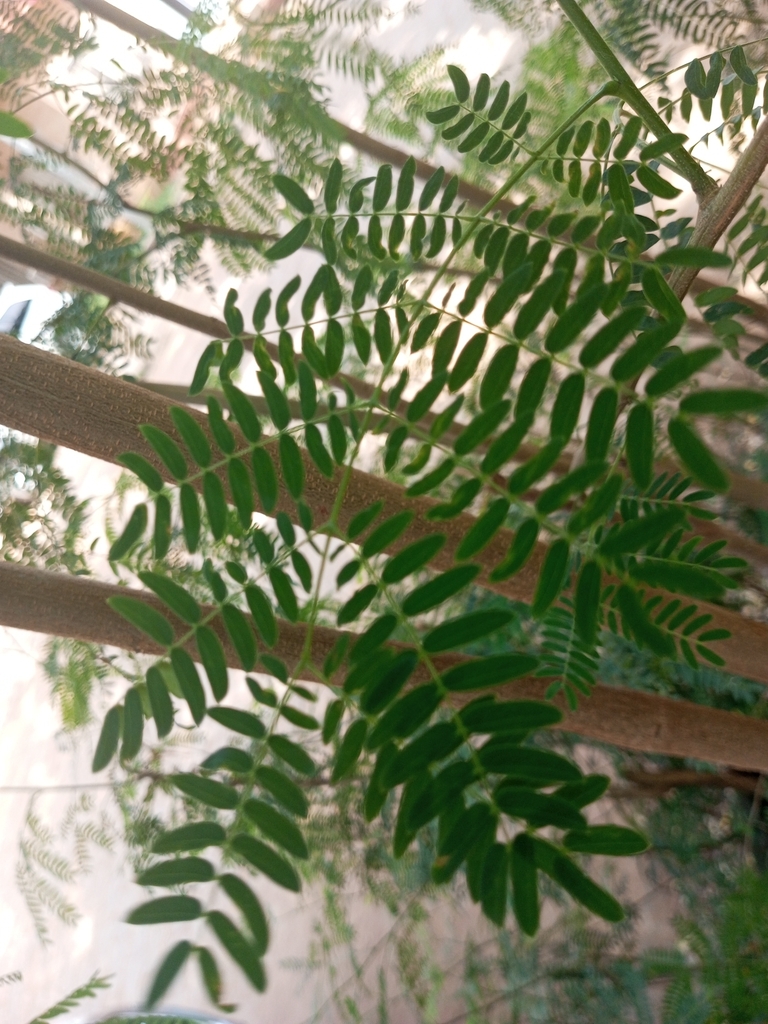
Scientific name: Leucaena leucocephala
Status: naturalized (from Mexico and Central America)
Height: 5–20 m, depending on variety (a short bushy type to ~5 m, a tall branched type to ~15 m, a tall unbranched "Hawaiian Giant" type to ~20 m)
Canopy width: ~10 m
Leaves: evergreen, open rounded crown
Special features: One of the fastest, most prolific pioneer fixers going — a classic fodder and firewood tree that seeds itself into cleared ground before almost anything else. That's exactly why it has a double reputation: a gift on degraded land, a nuisance weed where it's been let loose unchecked.
Guachipelín
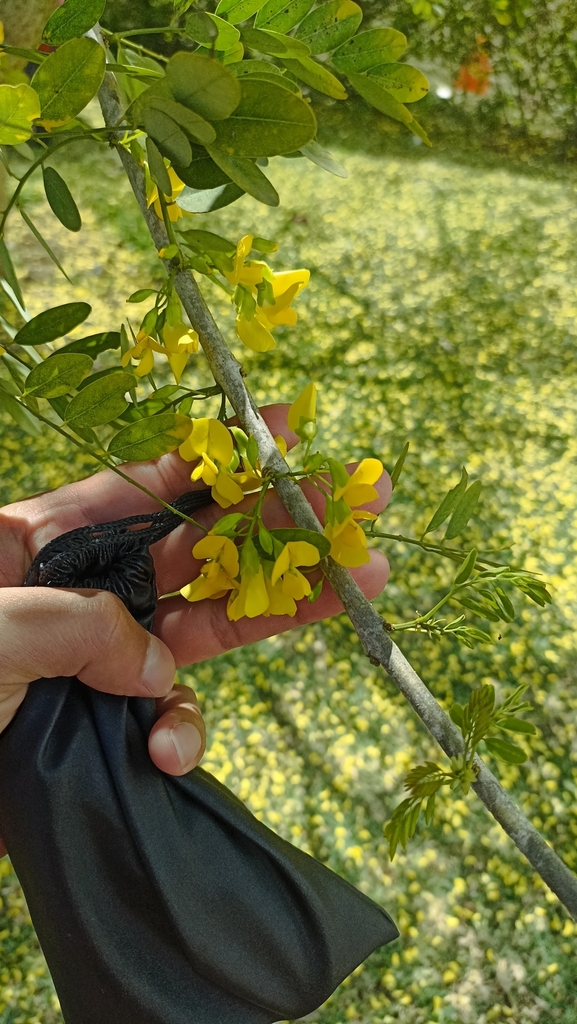
Scientific name: Diphysa robinioides (also treated as Diphysa americana)
Status: native
Height: 8–15 m (some sources report up to 22 m)
Canopy width: not documented
Leaves: drought-deciduous — sheds its feathery leaves in the dry season, replaced by masses of golden-yellow flowers
Special features: Common across the Nicoya Peninsula's dry forest and gets planted deliberately along riverbanks to stabilize soil on marginal land.
Cornizuelo
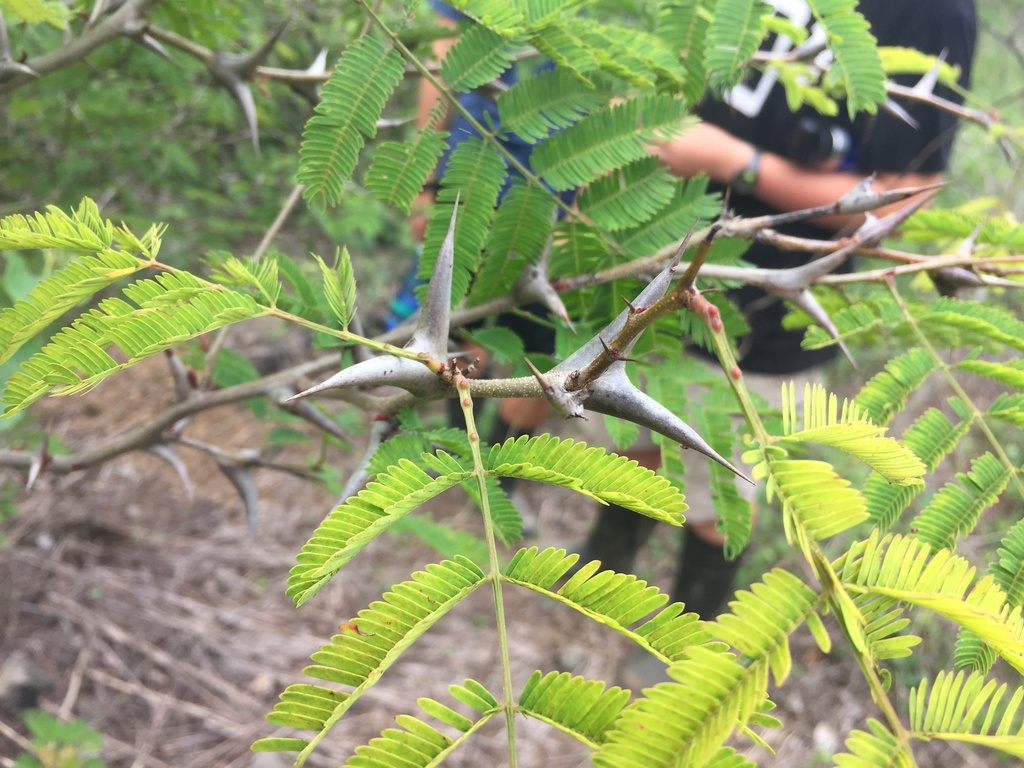
Scientific name: Vachellia collinsii (formerly Acacia collinsii)
Status: native
Height: 10–20 m (Costa Rica Tree Atlas; some generic/non-CR sources describe much shorter individuals, likely reflecting shrubbier growth outside the dry-forest form — worth a second look)
Canopy width: not documented
Leaves: drought-deciduous
Special features: Runs a stranger version of the usual pioneer job — it colonizes abandoned pasture fast and feeds the soil the usual way, but also grows hollow thorns it hands to a resident colony of ants, along with nectar and protein-rich leaf nubs, in exchange for defense so total that researchers at Santa Rosa National Park found experimentally ant-free trees dead within a year.
Guanacaste
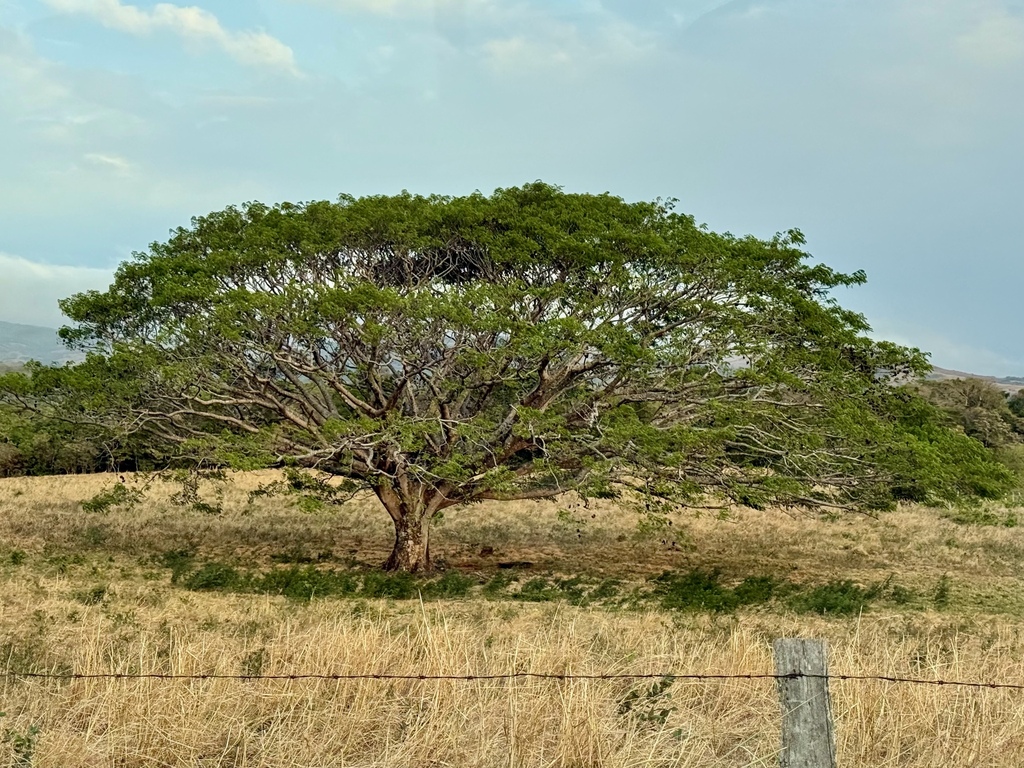
Scientific name: Enterolobium cyclocarpum
Status: native
Height: 25–35 m (occasionally reported to 40 m), trunk up to 3.5 m in diameter
Canopy width: 30 m or more
Leaves: drought-deciduous for a brief period in the dry season
Special features: Costa Rica's national tree, a broad, centuries-old giant named for its curled, ear-shaped pods. It fixes nitrogen like its smaller relatives — part of why the grass under a lone pasture guanacaste so often looks better than the grass around it.
Cenízaro
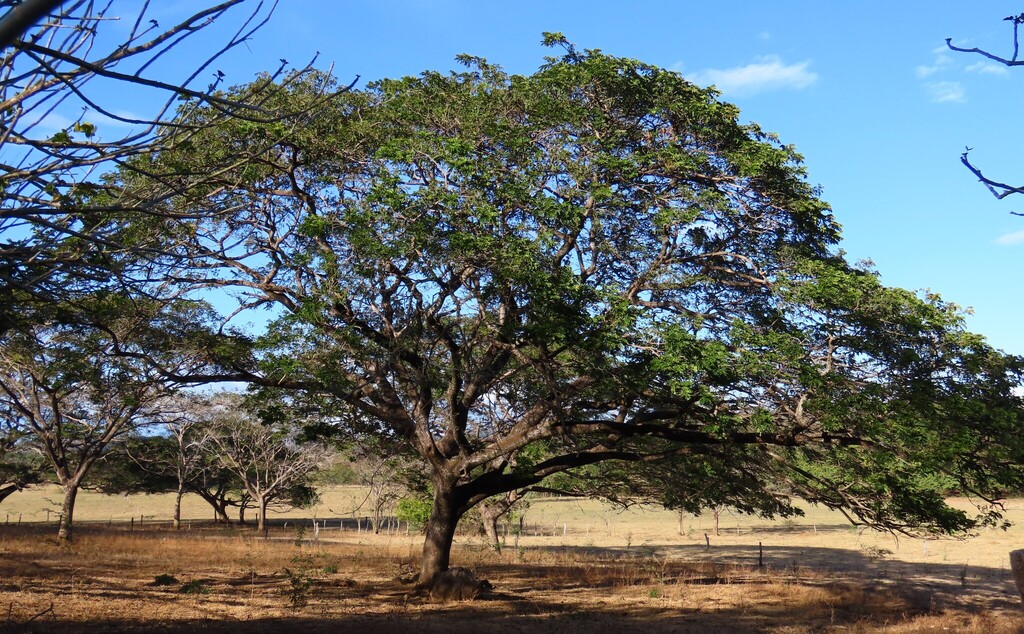
Scientific name: Samanea saman (syn. Albizia saman) — the rain tree
Status: naturalized (planted origin debated)
Height: 15–25 m
Canopy width: 30–60 m — mature specimens typically run two to three times wider than tall
Leaves: semi-deciduous, briefly bare in the driest part of the dry season; folds its leaflets shut at dusk and before rain
Special features: Long planted over cattle pasture for two reasons at once: shade for the herd, a nitrogen top-up for the grass beneath.
Poró
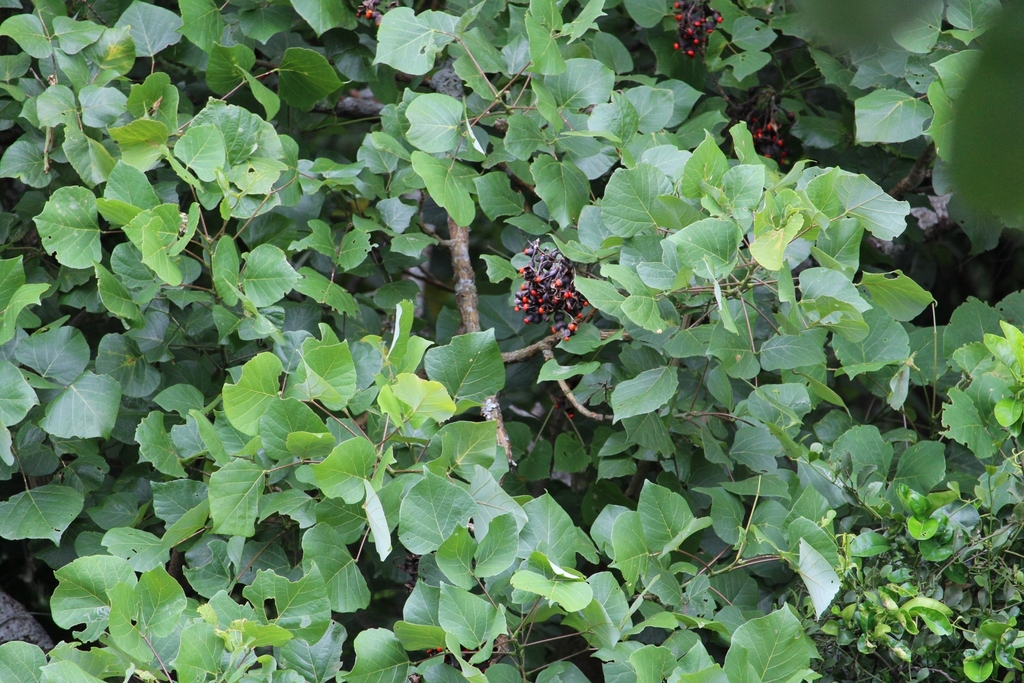
Scientific name: Erythrina berteroana
Status: native
Height: 10–12 m (some sources give up to 15 m)
Canopy width: not documented
Leaves: deciduous — flowers appear on bare branches
Special features: The tree Ticos push straight into the ground as a living fence post — bare gray wood one season, a column of blood-red, hummingbird-swarmed flowers the next.
Poró gigante
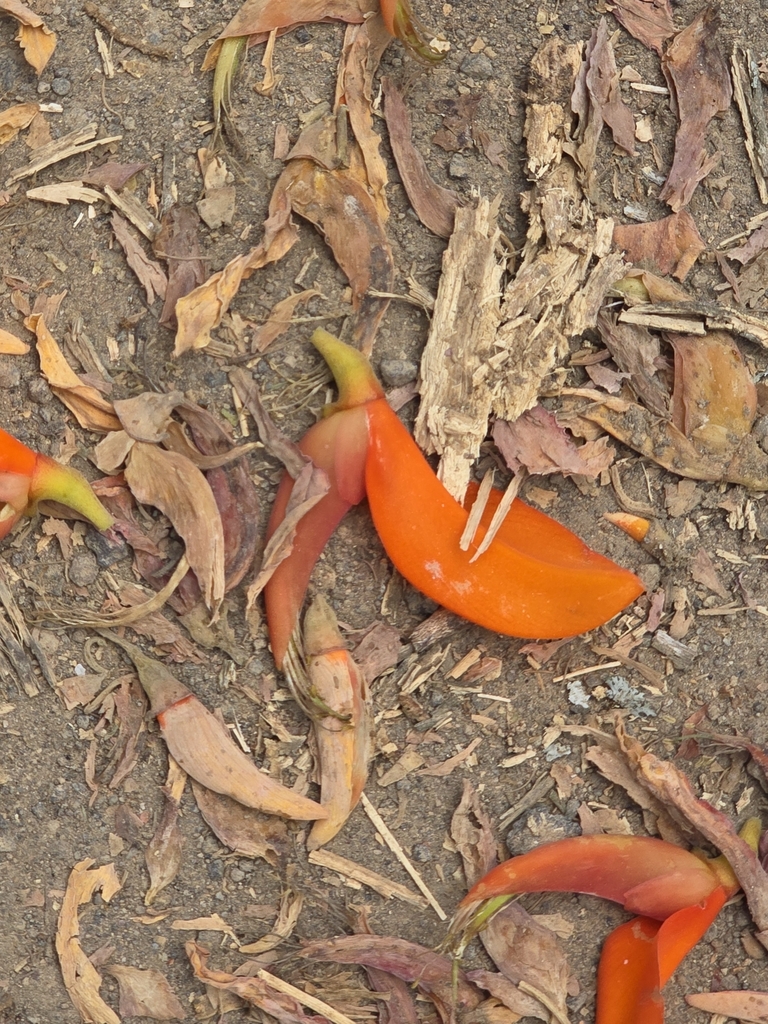
Scientific name: Erythrina poeppigiana
Status: naturalized (native to the Amazon and Orinoco basins; introduced to Costa Rica in the 1800s, now widespread)
Height: up to 35 m unpruned in the wild; in coffee cultivation it's lopped back to 2–3 m twice a year to promote flowering and berry ripening
Canopy width: not documented
Leaves: deciduous
Special features: Now the backbone of Costa Rica's coffee shade canopy. Field trials found its nitrogen contribution to neighboring coffee plants substantial enough that growers who keep a healthy stand can genuinely cut back on fertilizer.
Guaba común
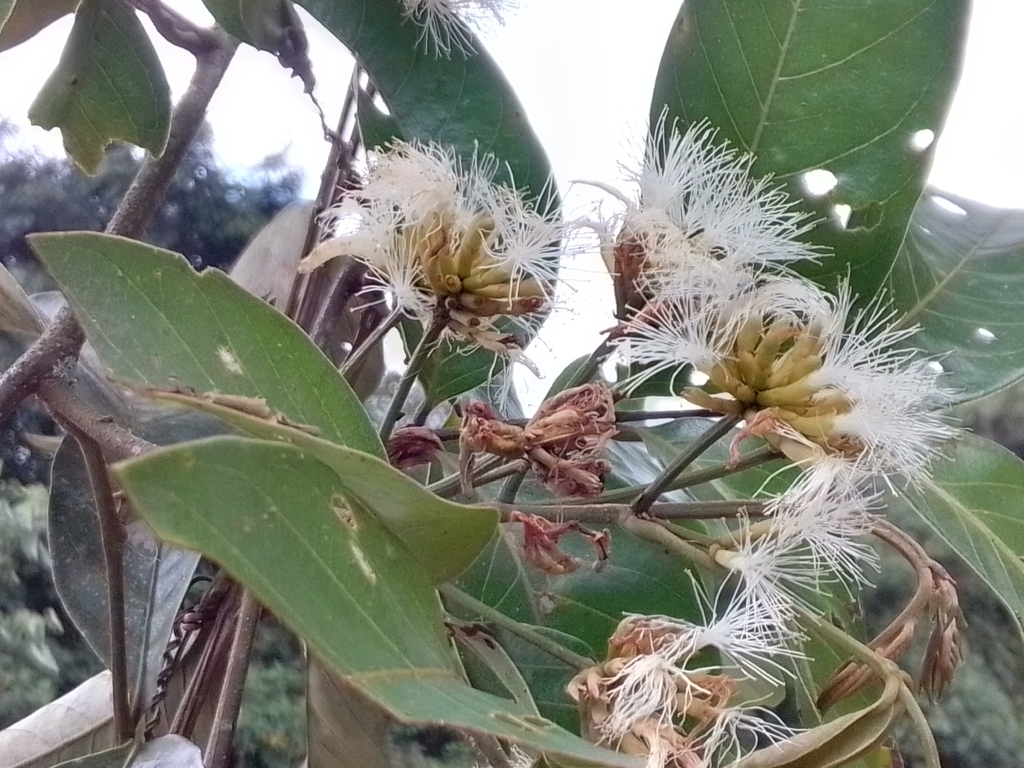
Scientific name: Inga punctata
Status: native
Height: 6–15 m typically (exceptional forest specimens have been measured to 30 m)
Canopy width: not documented
Leaves: evergreen
Special features: The genus nodulates with fast-growing Bradyrhizobium strains, which is exactly why Inga shades coffee and cacao farms across Central America while handing the farmer a second harvest for free — the pods split to a sweet, cottony pulp that really does taste like vanilla ice cream.
Guaba / ice-cream bean
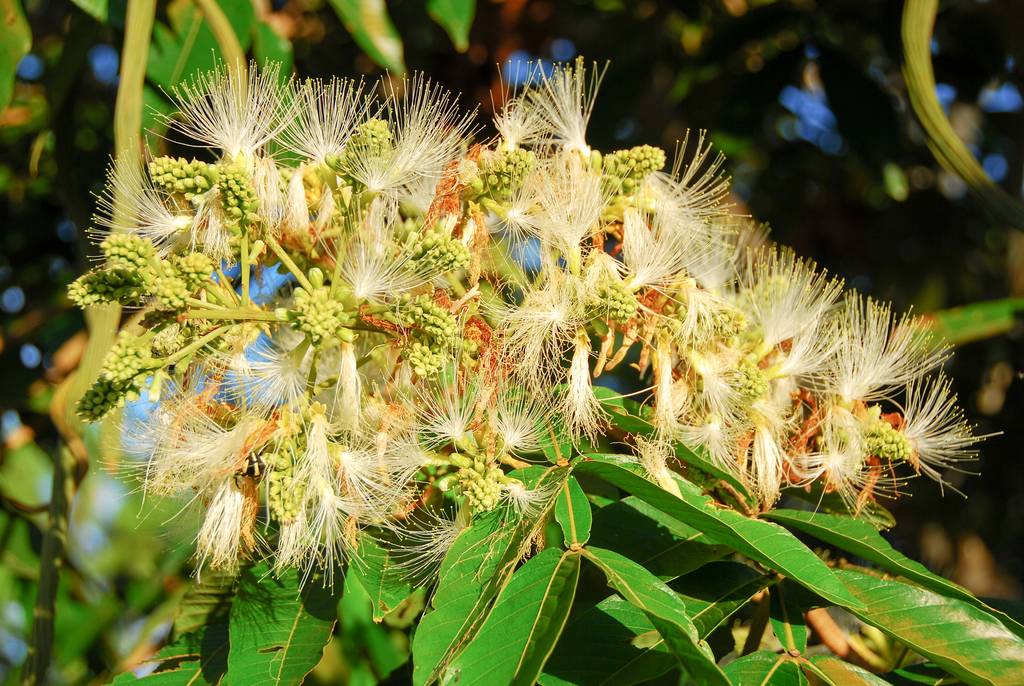
Scientific name: Inga edulis
Status: naturalized (Amazonian, widely planted)
Height: 15–25 m, occasionally to 30 m
Canopy width: 10–15 m, dense enough to cast deep shade on anything beneath it
Leaves: evergreen
Special features: The bigger-podded Amazonian cousin of guaba común, planted on purpose across the region for the same vanilla-tasting pulp and the same free nitrogen top-up for whatever's growing underneath.
Guamúchil
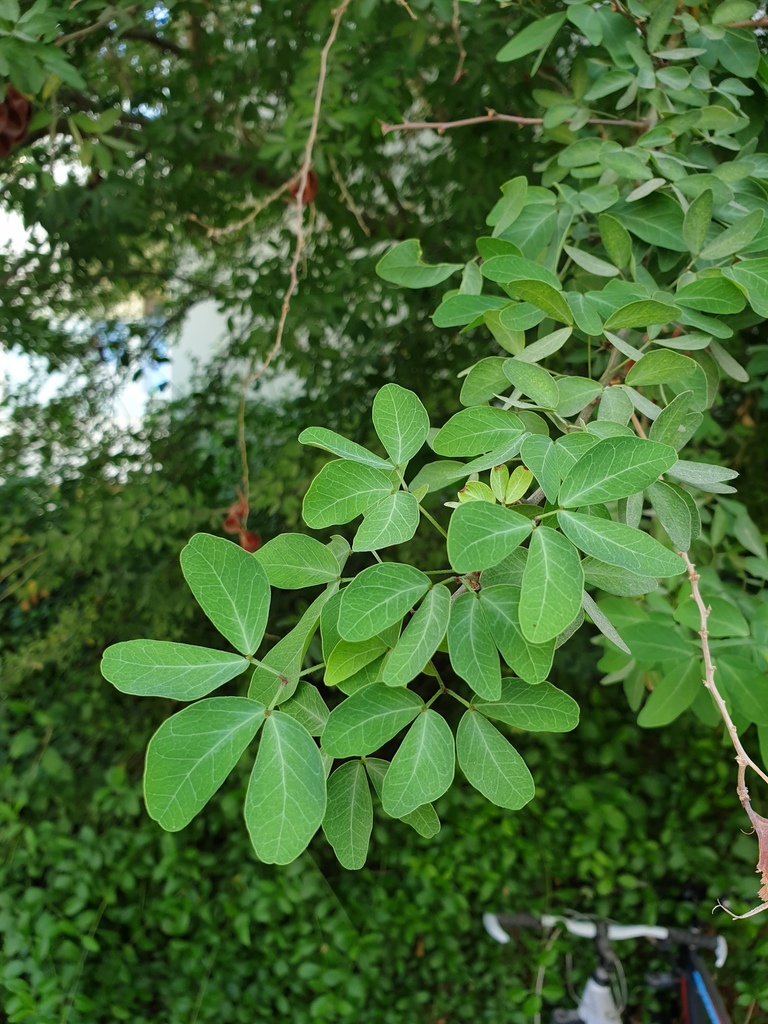
Scientific name: Pithecellobium dulce — Manila tamarind
Status: naturalized (from Mexico)
Height: 10–15 m
Canopy width: not documented
Leaves: semi-evergreen — leaflets drop and regrow in close succession, so the tree never looks fully bare
Special features: Splits open to a tangy-sweet pulp eaten straight off the tree or stirred into agua fresca, with the same nodulating habit found across its genus.
Almendro
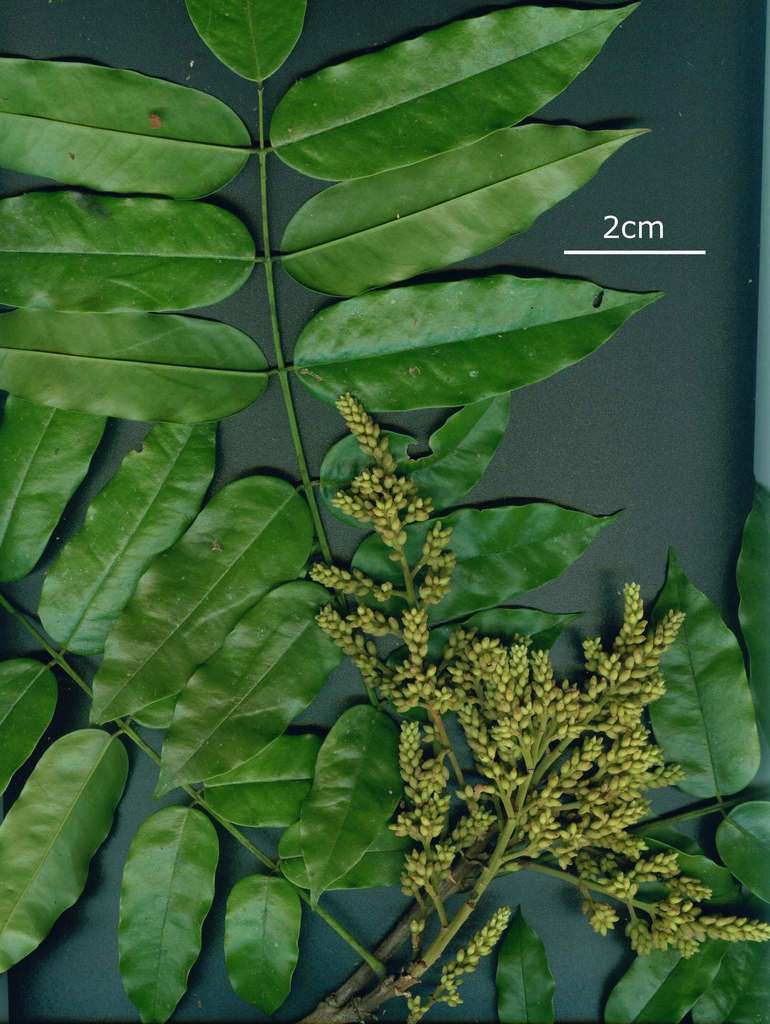
Scientific name: Andira inermis
Status: native
Height: sources vary widely — commonly cited at 20–25 m, with a documented range from 10 m up to 35 m for exceptional riverside specimens
Canopy width: not documented
Leaves: reported both ways in the literature — evergreen with continual leaf replacement in some accounts, briefly deciduous with a leaf-fall/flush cycle before flowering in others; not confidently resolved here
Special features: A Bradyrhizobium strain isolated from one growing wild in Costa Rica has had its genome fully sequenced.
Carbonero
Scientific name: Albizia adinocephala
Status: native
Height: commonly 10–15 m in Costa Rica, with some sources citing up to 18 m and old individual trees reported to 30 m
Canopy width: not documented
Leaves: phenology not clearly documented for this species specifically — omitted rather than guessed
Special features: A smaller native cousin of the rain tree, seen along Pacific roadsides and pasture edges doing the same unshowy nitrogen work on a smaller scale.
Quebracho
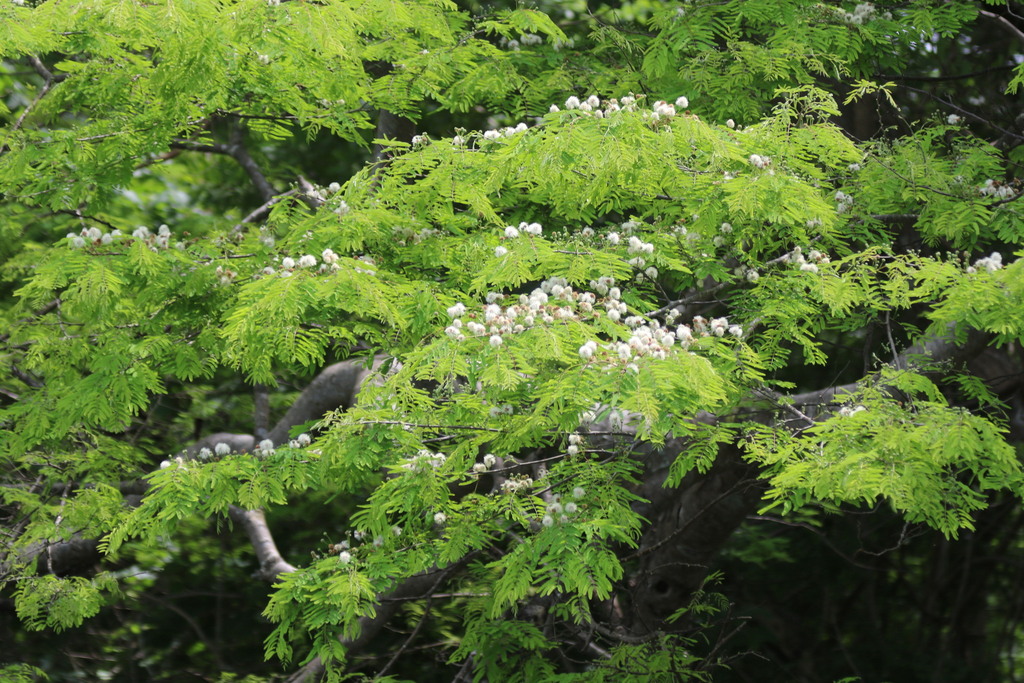
Scientific name: Lysiloma divaricatum
Status: native
Height: 8–15 m
Canopy width: not documented
Leaves: drought-deciduous, shedding roughly November–April and flushing back with the first rains
Special features: A common dry-forest native with a wide, feathery crown, among the earliest trees to recolonize abandoned pasture.
Calliandra
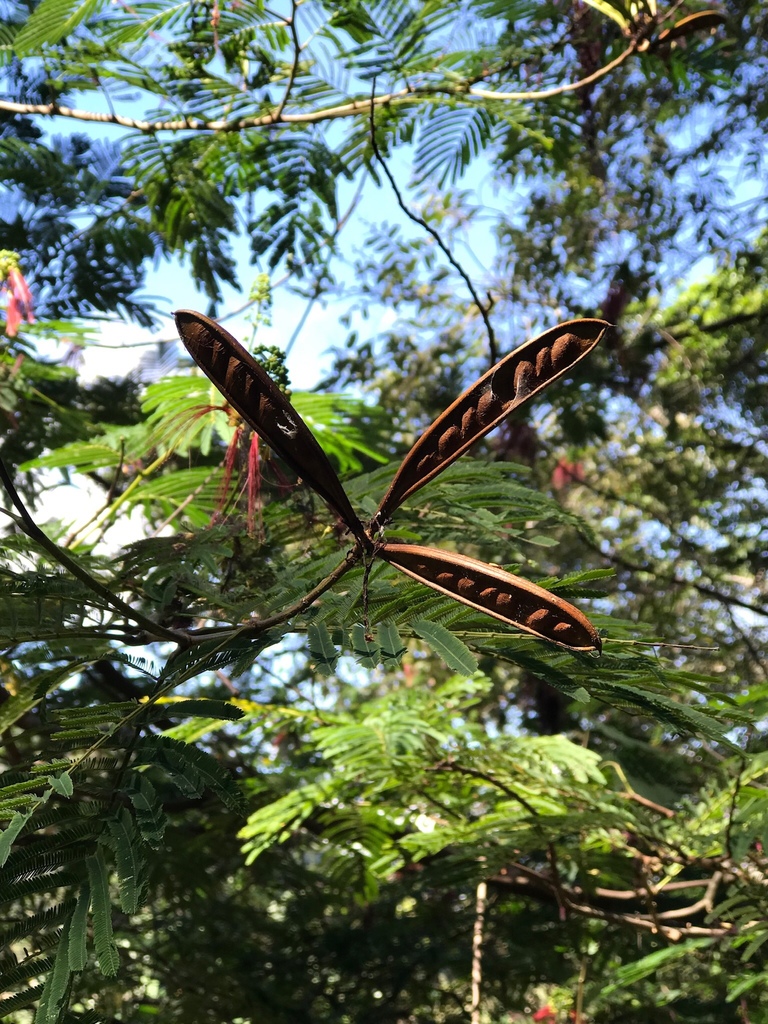
Scientific name: Calliandra calothyrsus
Status: naturalized (planted outside its original Central American range)
Height: typically 4–6 m, up to 12 m under good conditions
Canopy width: not documented
Leaves: evergreen in humid climates, semi-deciduous where the dry season runs long; its feathery leaflets fold shut at night regardless
Special features: Grows fast enough on poor soil to be cut for firewood within a year of planting — bright red "powderpuff" flowers included.
What's left out
Not every nitrogen-fixer in the region made this list. Cocobolo (Dalbergia retusa) — the rosewood so prized for knife handles that wild trees are now scarce and internationally protected — sits in a genus where nodulation is documented in other Dalbergia species, but cocobolo's own didn't turn up confirmed in the sources checked here, so it stays off the catalog above rather than get an assumed entry. Casuarina (Casuarina equisetifolia), the feathery tree planted on beaches worldwide, fixes nitrogen through an entirely different partnership — with a bacterium called Frankia, not rhizobia, proof the trick evolved more than once — but solid evidence it's actually established in Costa Rica, rather than merely able to grow here, didn't surface, so it's left off too. Other legume trees in the region likely fix nitrogen as well; this catalog covers the species with the clearest documentation, not an exhaustive list.
### A note on what's solid and what isn't
This piece was researched and written by AI. No fixation rates in kg N/ha/yr are cited — real figures vary too widely by site and method to state simply. Heights are given as documented ranges, which vary by source, growing conditions, and whether a specimen is cultivated or wild; where a canopy width or a leaf-phenology detail wasn't reliably documented for a species, it's been left out rather than estimated. All nodulation claims are made at the genus level unless a specific species was directly documented. Measurements are metric. Any photograph accompanying this piece is a real, credited image — not AI-generated; three (ice-cream bean, leucaena, and guamúchil) were photographed outside Costa Rica but are species-correct.
Sources: Costa Rica Tree Atlas (costaricatreeatlas.org) — guanacaste, guachipelín, cornizuelo entries; ACG — Área de Conservación Guanacaste (acguanacaste.ac.cr); Winrock International species factsheets on Gliricidia sepium, Enterolobium cyclocarpum, Albizia saman, Erythrina poeppigiana, Andira inermis, and Pithecellobium dulce (winrock.org); Useful Tropical Plants / tropical.theferns.info for Gliricidia sepium, Leucaena leucocephala, Erythrina berteroana, Andira inermis, Lysiloma divaricatum, and Albizia adinocephala; World Agroforestry / ICRAF species database (worldagroforestry.org, apps.worldagroforestry.org/treedb2) for Erythrina berteroana, Erythrina poeppigiana, and Calliandra calothyrsus; "The large mimosoid genus Inga Mill. … is nodulated by diverse Bradyrhizobium strains," Soil Biology and Biochemistry / ScienceDirect (sciencedirect.com/science/article/abs/pii/S0723202021000916); "Neotropical Legume Tree Inga edulis Forms N₂-fixing Symbiosis with Fast-growing Bradyrhizobium Strains," Plant and Soil / Springer (link.springer.com/article/10.1007/s11104-005-0808-8); "High-quality permanent draft genome sequence of Bradyrhizobium sp. Ai1a-2, a microsymbiont of Andira inermis discovered in Costa Rica," Standards in Genomic Sciences / Springer (link.springer.com/article/10.1186/s40793-015-0007-z); Plants of the World Online, Kew (powo.science.kew.org) for native-range verification of Erythrina poeppigiana, Inga species, and Lysiloma divaricatum; rngr.net USDA Forest Service tropical tree seed manual species profiles for Diphysa robinioides and Albizia adinocephala; field studies on Vachellia collinsii ant-mutualism from Santa Rosa National Park, Área de Conservación Guanacaste; University of Costa Rica (UCR) and Costa Rica Institute of Technology (TEC) studies on nodulation capacity across Costa Rican legume forest species.
### Photo credits
All photographs are real, credited Creative Commons images from iNaturalist (no AI-generated imagery). Three species (ice-cream bean, leucaena, guamúchil) were photographed outside Costa Rica but are species-correct.
- Gliricidia sepium — CC0, via iNaturalist (observation 290783693)
- Leucaena leucocephala — © ONG SOS Biodiversity, CC BY, via iNaturalist (observation 160744572)
- Diphysa robinioides — CC0, via iNaturalist (observation 258675590)
- Vachellia collinsii — © Reid Hardin, CC BY, via iNaturalist (observation 68393512)
- Enterolobium cyclocarpum — CC0, via iNaturalist (observation 305325316)
- Samanea saman — © Mary Beth Stowe, CC BY, via iNaturalist (observation 341101080)
- Erythrina berteroana — CC0, via iNaturalist (observation 52858920)
- Erythrina poeppigiana — CC0, via iNaturalist (observation 259599140)
- Inga punctata — © Arthur de Jesús Chavarría Pérez, CC BY, via iNaturalist (observation 61329523)
- Inga edulis — CC0, via iNaturalist (observation 121055825)
- Pithecellobium dulce — © Jacky Judas, CC BY, via iNaturalist (observation 64297371)
- Andira inermis — © Eduardo Chacón Madrigal, CC BY, via iNaturalist (observation 52706672)
- Lysiloma divaricatum — © Cricket Raspet, CC BY, via iNaturalist (observation 221465182)
- Calliandra calothyrsus — © ldgc, CC BY-SA, via iNaturalist (observation 19735521)
Made using AI.