 ramakaterra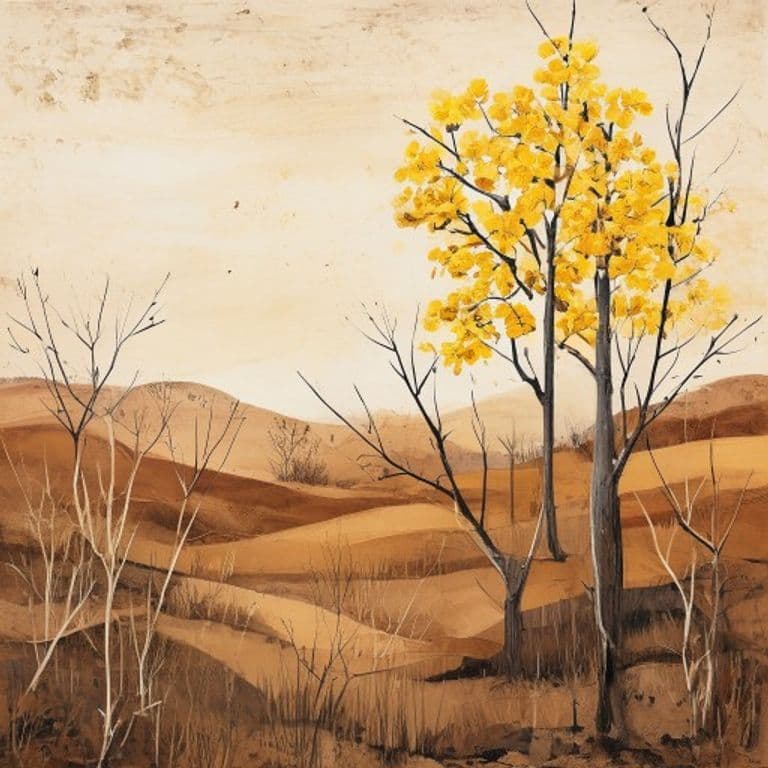
The Tree That Blooms When It Looks Dead
Did you know a forest can look completely dead for months and be perfectly fine?
On the Nicoya Peninsula the rains stop around December, and by March the hills have gone brown and bare — leaves yellowed, curled, and dropped, leaving a lattice of gray branches against a hard blue sky. To a first-time visitor it looks alarming. It isn't. This is the tropical dry forest — bosque seco tropical — doing exactly what it evolved to do.
Most of the trees here are deciduous: they drop their leaves in the dry months to stop losing water. A leaf is a place where water escapes, so a tree with no leaves loses almost none. It's a clever trick — but an honest look says it isn't a rare one. It's the same logic a bare winter tree uses against the cold, just aimed at drought instead of frost. Plenty of trees, in plenty of places, shed their leaves to save themselves.
Here's the part that isn't ordinary.
In the depths of the dry season — when the hills are at their most skeletal, drawing on no visible water — certain trees erupt in flower while still completely leafless. The showstopper is the corteza amarilla (Handroanthus ochraceus). You could walk past it all year without a glance. Then its bare crown detonates: a dense, almost fluorescent yellow, no leaves anywhere, just flower, so saturated it looks lit from inside. You can pick one out from across a valley.
The timing is the strangest part. The trees don't bloom on a date — they bloom on a cue. An unseasonal shower or a snap of cooler air, and then, about nine or ten days later, they all open at once. Every corteza amarilla for miles flowers within the same few days, so the yellow appears across a whole region as if overnight. Then it's gone — the flowers last only four or five days before they fall and carpet the ground.
The synchrony is the whole strategy. One tree in bloom is easy for a bee to miss. Ten thousand trees blooming on the same three days, leafless, at the one moment almost nothing else is offering — that's impossible to ignore. It's simply a way of making every pollinator for miles come to you first.
Its pink cousin, the roble de sabana (Tabebuia rosea), runs the same trick in pastel, a week or two apart. Between them the forest blooms in relays through the driest, quietest months: a yellow week, a pink week, bare branches in the gaps. The hillside that looks most dead is the one throwing the most color.
Worth knowing, too: this is rare in more ways than one. Tropical dry forest is one of the most endangered habitats in the Americas — roughly 80% of Central America's has been cleared, much of it for cattle pasture. What survives here does so largely thanks to decades of stubborn conservation work in Guanacaste. A dry forest, once gone, is thought to need two to four hundred years to fully return.
So the next time a hillside looks brown and finished, look again. Somewhere in that gray, a tree is quietly counting the days since the last cool morning — keeping a private appointment it will then, suddenly and briefly, keep in front of everyone.
Made using AI. This is a research-based post, not a first-hand account. Flowering timing shifts year to year with the weather; exact bloom dates cannot be predicted far in advance.
Sources verified live (2026-07-29):
- Tropical dry forest of Guanacaste/Nicoya, dry season Dec–mid-May, deciduous trees dropping leaves and turning brown, leaf drop as water conservation: Costa Rica Guide — Tropical Dry Forests Ecozone; Vacations Costa Rica — Tropical Dry Forests
- Central American dry forest: ~5–8 month dry season, semi-deciduous, ~80% of the ecoregion converted to cities/cattle ranches/plantations: One Earth — Central American Dry Forests
- Corteza amarilla (Handroanthus/Tabebuia ochracea): flowers ~9–10 days after a cool/rain day in the dry season, blooms last ~4–5 days, highly synchronized "big-boom" flowering across a whole population, leafless while flowering, attracts bees/wasps/flies/hummingbirds: Trees of Costa Rica's Pacific Slope — Tabebuia ochracea; ACG Rothschildia — El Árbol Corteza Amarilla
- Roble de sabana (Tabebuia rosea): pink/lavender/white flowering while leafless in the height of the dry season: Trees of Costa Rica's Pacific Slope — Tabebuia rosea; Wikipedia — Tabebuia rosea
- Dry forest as one of the most endangered Mesoamerican habitats; Guanacaste conservation; recovered dry forest estimated to need ~200–400 years to regenerate: Voz de Guanacaste — Guanacaste, the Last Hope for Mesoamerican Dry Forests; Guanacaste National Park (Costa Rica) — Wikipedia)